

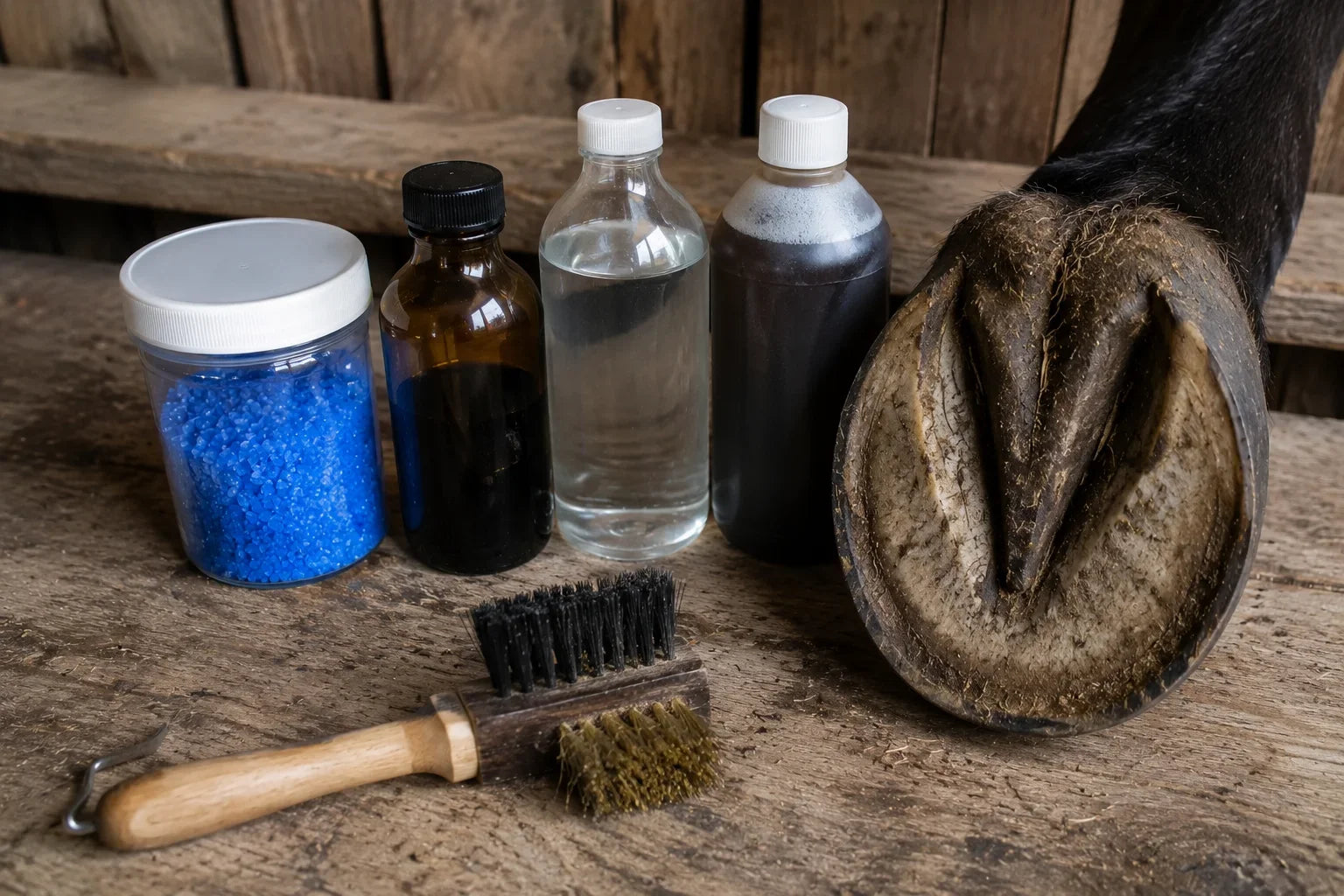
Comparing home remedies objectively and assessing them safely
Have you discovered black residue, soft horn or an unpleasant smell while picking out the hoof? Then you are probably looking for a quick solution. Numerous home remedies for thrush in horses are recommended online: copper sulfate, iodine, vinegar, hydrogen peroxide, toothpaste or various self-mixed solutions.
Some of these substances have been used in hoof care for a long time. However, this does not mean that every home remedy is suitable for every hoof, concentration or stage of thrush. If used incorrectly, an apparently harmless attempt can worsen the condition, further irritate sensitive tissue and delay effective treatment.
In this guide, we show you which home remedies are commonly used, where their limitations lie, and why sustainable improvement always also involves cleaning, professional hoof trimming, management and identifying the causes.

Olaf's note on home remedies
“If used incorrectly, a home remedy can turn a small problem into a significantly bigger one.” A surface that looks dry or clean in the short term says nothing about whether deeper areas have been reached. Especially in narrow, poorly ventilated frog grooves, the underlying problem may persist.
That is why Olaf and the Hoofgold team advise you: Do not experiment randomly, do not mix products on your own, and whenever possible use products specifically developed for the equine hoof, clearly declared and with instructions that are easy to follow.
Which home remedies help with thrush?
There is no home remedy that reliably resolves every case of thrush regardless of its cause and severity. Some substances may have a superficial drying or germ-reducing effect. However, they provide only limited help when:
- loose or damaged horn blocks access,
- the change lies deep in a narrow frog groove,
- the hoof becomes damp and dirty again every day,
- an unfavorable hoof shape or hoof balance persists,
- sensitive or bleeding tissue is affected, or
- another condition is mistakenly assumed to be thrush.
Why is a home remedy alone often not enough?
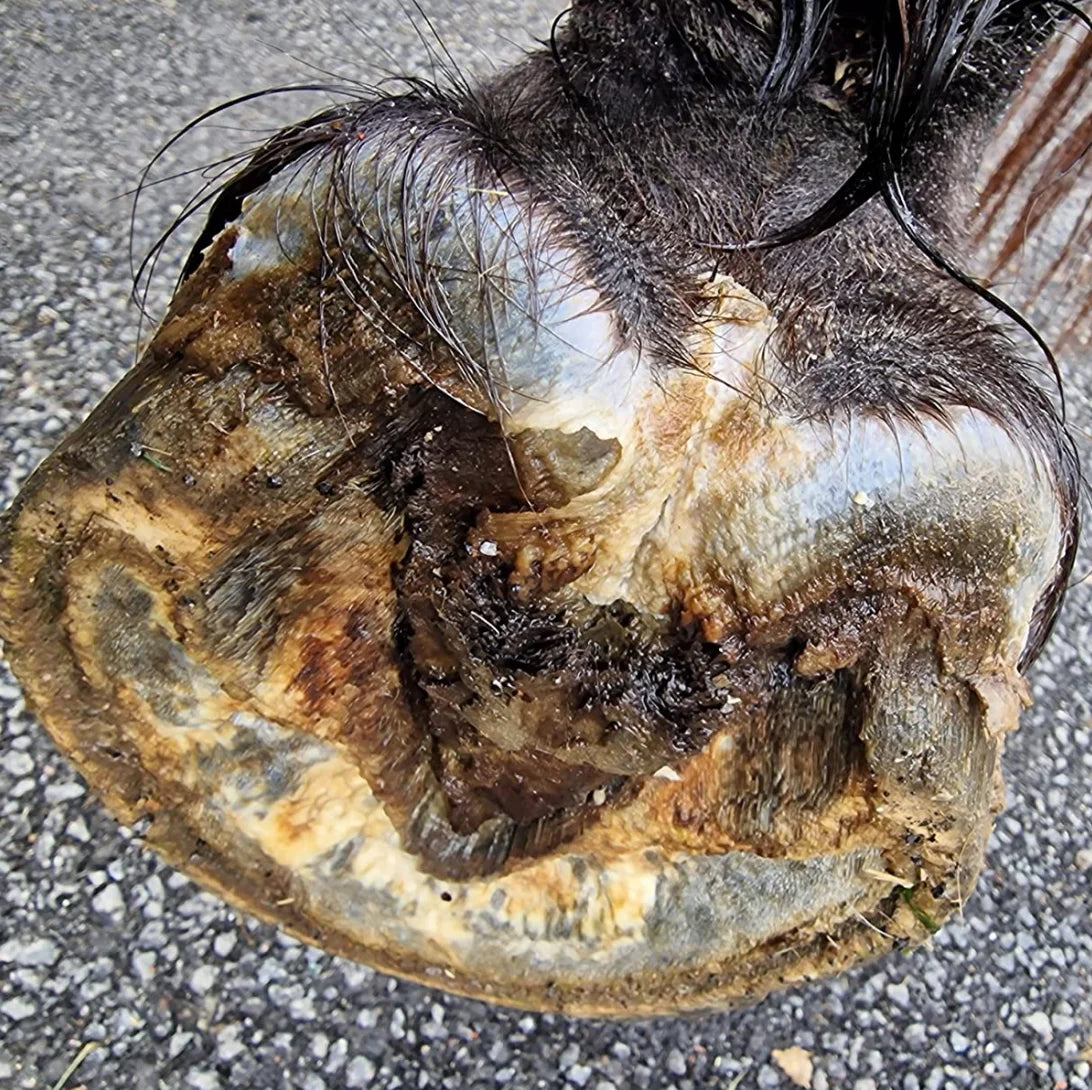
Thrush does not affect only the visible surface. The change may be located deep in the central or collateral sulcus. Loose horn, moisture, and organic material can make access difficult there.
If a product is merely applied to a dirty or closed-off area, it may not reach the actual problem zone. Therefore, the following must first be checked:
- Is the affected area accessible?
- Is there loose or undermined horn over it?
- Is the sulcus deep, narrow, or painful?
- Does the hoof remain permanently damp?
- Is the horse lame or sensitive?
- Is the diagnosis actually certain?
A successful care routine therefore consists of several components:
- Assess the hoof
- Remove coarse dirt
- Make damaged areas professionally accessible
- Apply suitable local care
- Improve management and moisture control
- Review hoof care and exercise
- Monitor progress consistently
You can find the complete procedure later via the internal link: Treating thrush: step-by-step guide .
Copper sulfate for thrush
Copper sulfate is one of the best-known traditional hoof-care products. It is often used in powder form, as an ingredient in ready-made products, or in self-mixed solutions.
Why is copper sulfate used?
Copper compounds are often used because they have a drying effect on horn and can influence the growth of certain microorganisms. This is why they are also found in various commercial hoof-care products.
Where are the limits?
The effect depends heavily on:
- the concentration at which the copper sulfate is used,
- whether it is applied dry, dissolved, or in a carrier product,
- how deep the change extends,
- whether only dead horn or already sensitive tissue is affected,
- how often it is applied, and
- whether the hoof becomes permanently damp again afterward.
A high concentration is not automatically better. Strongly drying or irritating effects can be problematic when the tissue is already open, sensitive, or injured.
Do not put copper sulfate blindly into deep sulci
With a deep central frog sulcus, it is often unclear how far the damage extends. A powder or concentrated solution should therefore not be introduced uncontrollably deep into a painful or bleeding cleft.

Iodine and iodine-based products for thrush
Iodine-based solutions have also traditionally been used to clean and care for hoof areas. Their suitability likewise depends on the concentration, product form, and condition of the affected area.
Potential advantage
Iodine-based products may have a cleansing and antimicrobial effect. In a suitable form, they can therefore be part of a controlled care routine.
Potential disadvantage
Using a solution that is too concentrated or applying it too frequently can irritate the tissue or cause severe drying. In particular, open, bleeding, or deep areas should not be treated without professional assessment.
Equally important: An iodine-based product does not resolve contracted heels, a deep horn pocket, or a persistently dirty environment.
Does vinegar help against thrush?
Vinegar is often recommended because it is acidic and can alter the environment on the hoof surface. Some horse owners use diluted household vinegar or apple cider vinegar.
Potential benefits
- readily available,
- cost-effective,
- easy application to superficial areas.
Limitations and potential problems
- The concentration is often not controlled.
- Open or irritated tissue may react sensitively.
- Vinegar does not automatically reach deep, closed pockets.
- It does not eliminate any underlying hoof or management issue.
- Its use can delay a professional diagnosis.
A hoof that appears clean on the surface does not automatically mean that the problem in a deep groove has been resolved.
Hydrogen peroxide for thrush
Hydrogen peroxide is known for its foaming reaction. This visible reaction can quickly create the impression of particularly thorough cleaning.
However, foaming does not automatically mean that damaged tissue is healing sustainably or that a deep pocket has been properly treated. Repeated application to sensitive tissue can cause additional irritation.
Hydrogen peroxide should not be used on deep, open, or bleeding areas without professional advice.
Toothpaste and other unusual internet home remedies
Toothpaste, mouthwash, alcohol, bleach, essential oils, or homemade pastes are sometimes recommended in forums and social media. Such tips often arise from individual personal experiences.
Toothpaste is water-soluble or is washed away by moisture. At the next damp spot, in wet bedding, or in a puddle at the latest, it can dissolve - and the supposed protective effect is no longer reliably present. In addition, its composition was not developed for damaged hoof horn.
The problem is:
- The exact composition was not developed for horse hooves.
- Concentration and tissue compatibility are often unclear.
- Products may contain fragrances, surfactants, or other irritating substances.
- A single case does not prove general effectiveness.
- The visible drying can be mistaken for genuine improvement.
Products that act only on the surface may initially make a good impression because the hoof looks drier or cleaner. However, this does not prove that deep, poorly ventilated areas have been reached. If moisture, organic material, or damaged horn remains there, conditions may persist in which oxygen-deprived microorganisms thrive.
Mixtures whose ingredients affect one another or that are applied directly to sensitive tissue are particularly problematic. A paste can also unfavorably seal a deep groove and trap compromised material if the hoof has not been properly prepared beforehand.
Home remedies for thrush compared
| Product | Why is it used? | Possible limitation | Special caution |
|---|---|---|---|
| Copper sulfate | Drying and antimicrobial properties | Does not address the mechanical cause | Open or sensitive tissue |
| Iodine | Cleansing and antimicrobial effects | Concentration and frequency are key | Deep, irritated, or bleeding areas |
| Vinegar | Changes the surface environment | May not reach deep pockets | Undiluted or frequent use |
| Hydrogen peroxide | Visible foaming reaction | Foaming is not proof of healing | Sensitive or open tissue |
| Toothpaste and mixtures | Readily available, drying consistency | Not developed for horse hooves | Unclear ingredients and tissue compatibility |

What risks do aggressive home remedies pose?
The most common assumption is: The stronger a product smells, stings, or dries out, the more effective it must be. This conclusion is wrong.
Possible risks of unsuitable or overly concentrated products include:
- Irritation of sensitive tissue,
- severe drying of healthy hoof horn areas,
- additional pain,
- concealment of a deeper problem,
- delayed professional treatment,
- uncontrolled chemical reactions in mixtures.
Tissue that is irritated, dried out or treated incorrectly too often can become increasingly sensitive and make further care more difficult. What initially looks like a cheap shortcut often costs more time and money - at the expense of your horse's well-being.
You should be especially careful in the case of bleeding, open areas, a clear pain response and very deep grooves.
The hoof horn itself does not bleed. Blood indicates that sensitive tissue has been reached or injured. In this case, no further experimentation should be carried out.
Do not mix products with one another
Many horse owners try several remedies one after another or mix them together. But are the ingredients chemically compatible? Are the concentration, pH value and application coordinated with one another? Without clear information from the manufacturer, this cannot be assessed reliably.
Therefore, do not mix hoof-care products, home remedies or active ingredients on your own. Do not clean the hoof with one product and apply another immediately afterward unless the manufacturer expressly provides for this combination. If in doubt, ask the manufacturer, veterinarian or hoof-care professional.
Doping and medication in sport horses
For sport horses, you must also check whether the ingredients of a care product are permitted under the currently applicable anti-doping and medication control rules and whether a withdrawal period must be observed. Do not rely solely on terms such as “natural” or “for external use”.
Check the complete declaration in the current ADMR search engine of the German Equestrian Federation and clarify unclear products with a veterinarian, manufacturer or responsible association before using them at a competition.
When can a home remedy be useful at all?
A simple remedy can at most be part of a care routine if:
- the change is superficial,
- there is no lameness or strong pain response,
- no sensitive or bleeding tissue is visible,
- the affected area is clean and accessible,
- the concentration and application are known,
- the progression is monitored closely and
- Management and hoof care should be improved at the same time.
Even then, use should be discontinued and professional advice sought if the condition worsens or no improvement is apparent within a reasonable period.
The better plan for thrush
Rather than searching for the strongest or supposedly cheapest home remedy, it is more sensible to structure the treatment directly in clear steps. Improperly used home remedies often do not save money: if the condition worsens, they result in additional effort, longer treatment times, and further costs.
“No hoof, no move”: Without a healthy, resilient hoof, your horse cannot move freely. Its hoof health and well-being should therefore always take priority over a short-term budget solution.
1. Clean the hoof
Remove coarse dirt and make the affected areas visible. Work carefully and do not injure sensitive tissue.
2. Have loose or damaged areas assessed
Undermined hoof horn and deep pockets can prevent the treatment from reaching the problem area. Professional trimming should be entrusted to experienced hands.
3. Use hoof-specific care
Choose a professional hoof-care product developed specifically for horses' hooves whenever possible. Its formulation, application, and intended use are more clearly defined than those of random household mixtures. Even a professional product must be used exactly as directed and in accordance with the condition of the tissue.
4. Improve moisture control and hygiene
Cleaner and drier feeding and resting areas reduce renewed strain on the freshly cared-for hoof.
5. Review hoof care and exercise
Deep grooves, contracted heels, and limited hoof mechanism can cause the problem to keep recurring.
A detailed comparison follows in the supplementary article: Which remedy for thrush is suitable? .
When should home remedies be set aside?
If any of the following signs are present, do not continue experimenting with home remedies:
- The horse is lame or walking noticeably tender-footed.
- The frog is bleeding.
- The change extends deep between the bulbs.
- The hoof is warm or swollen.
- Abnormal or proliferating tissue is growing.
- The condition is worsening despite care.
- Several treatment attempts have been unsuccessful.
- It is unclear whether this is thrush, hoof cancer, or another problem.
In these cases, a veterinarian and qualified hoof-care professional should assess the hoof.
Hoofgold practical tip
Olaf's practical tip: In practice, the strongest remedy is not automatically the best. A suitable product can only work effectively if the affected area is clean, accessible, and prepared according to the condition of the tissue.
Recurring thrush is often an indication that an underlying cause remains. These include:
- deep or narrow collateral grooves,
- undermined hoof horn,
- persistent moisture,
- too little exercise or
- an unsuitable hoof trimming.
Therefore, consider each remedy only as part of a complete hoof-care plan. Do not use unclear mixtures or switch randomly between active ingredients. Tissue that is treated incorrectly too often can become increasingly difficult to care for - taking the professionally correct approach early on protects time, money, and above all your horse's well-being.

Frequently asked questions about home remedies for thrush
Which home remedy works best against thrush?
There is no home remedy that is best for every hoof and every stage. The depth of the change, tissue condition, thorough preparation, and elimination of the underlying causes are decisive.
Does copper sulfate help against thrush?
Copper sulfate has traditionally been used for its drying and antimicrobial properties. However, concentration, method of application, and tissue condition are crucial. Highly concentrated applications can be problematic on sensitive tissue.
Can copper sulfate be applied directly to the frog groove?
Not without proper control. Particularly deep, painful, or bleeding grooves should first be professionally assessed. A strong product should not be blindly applied into a hard-to-see crevice.
Does vinegar help against thrush?
Vinegar can alter the environment on the surface. However, it does not eliminate deep horn pockets, poor hoof balance, or persistently damp living conditions.
Can apple cider vinegar be used?
Apple cider vinegar is often mentioned as a home remedy. Here too, dilution, tissue condition, and application are crucial. Do not experiment on open or sensitive areas without professional advice.
Is iodine good for thrush?
Iodine-containing products may have a cleansing and antimicrobial effect. Applications that are too concentrated or too frequent can irritate sensitive tissue or dry it out excessively.
Does hydrogen peroxide help against thrush?
The foaming reaction may loosen dirt, but it does not prove lasting healing. Repeated application to sensitive tissue may cause additional irritation.
Can toothpaste be applied to the frog?
Toothpaste was not developed for horse hoof care. It is water-soluble or washed away by moisture and may contain fragrances, surfactants, and other ingredients whose effects on damaged hoof tissue are not intended for this purpose.
Can I mix different remedies for thrush?
Do not use them without explicit manufacturer instructions or professional advice. Ingredients can interact with one another, irritate the tissue, or alter their effects. Use products individually as directed and discuss planned combinations with the manufacturer, veterinarian, or hoof-care professional.
What do I need to consider for a competition horse?
Before use, check the complete declaration and the current anti-doping and medication-control rules. Depending on the ingredients and method of application, a withdrawal period may apply. Use the current ADMR search engine for this and ask your veterinarian, the manufacturer or your association if you are unsure.
Can a home remedy completely cure thrush?
A single remedy rarely addresses all the causes. Sustainable improvement often requires cleaning, professional hoof trimming, local care, drier conditions and regular monitoring.
When should I stop using home remedies?
In cases of bleeding, lameness, severe pain, deep lesions, heat, swelling, abnormal tissue or no improvement, professional help should be sought.
What is better: home remedies or a ready-made hoof-care product?
A ready-made product has the advantage that its composition, intended use and instructions are clearly defined. However, even a ready-made product does not replace proper preparation and addressing the underlying causes.
Why does thrush return despite home remedies?
Deep grooves, moisture, loose horn, little movement or unfavorable hoof balance often remain. As long as these factors are not addressed, the problem may recur.
Not the strongest remedy, but the right overall plan
You don't have to experiment on your own. Home remedies may have individual properties, but they rarely address all the causes of thrush. What matters is an accessible hoof, consistent care, suitable hoof trimming and better living conditions.
With a professionally appropriate care solution, you not only avoid unnecessary detours but above all protect your horse's well-being. Olaf and the Hoofgold team are here to support you with practical knowledge and advice.
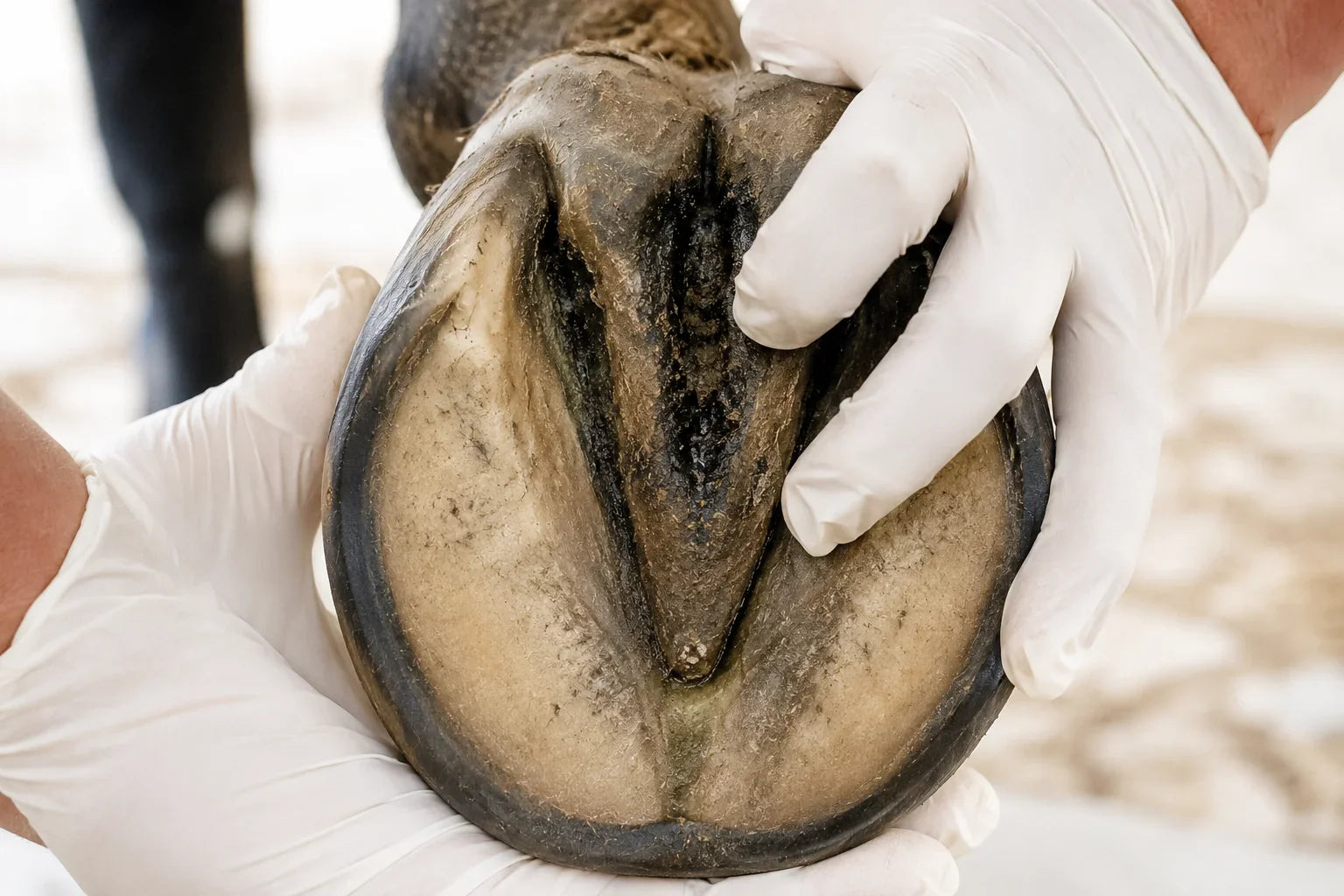
Discover Hoofgold thrush care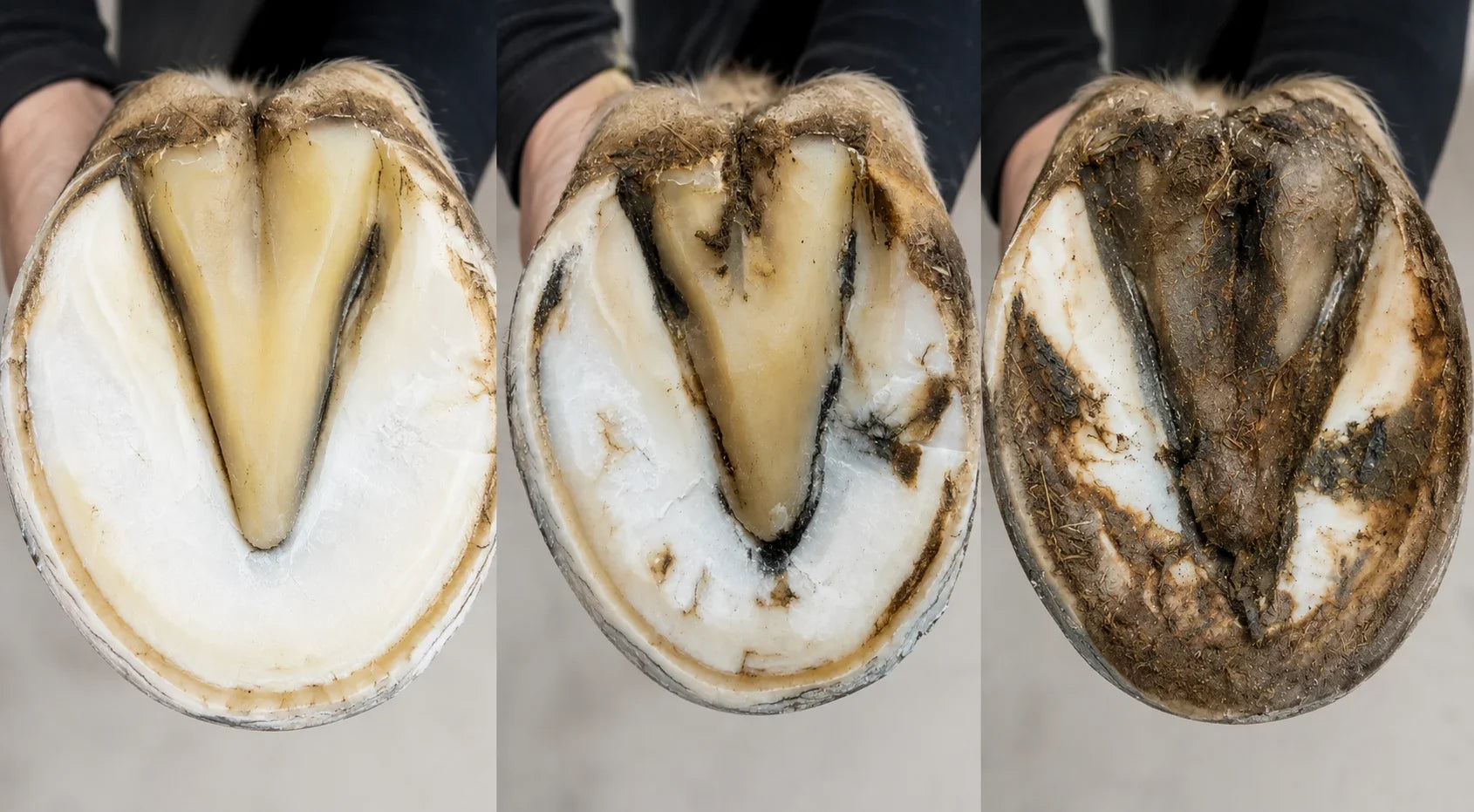
Share:
Recognizing thrush in its early stages: The first warning signs
Which treatment for thrush is effective?