
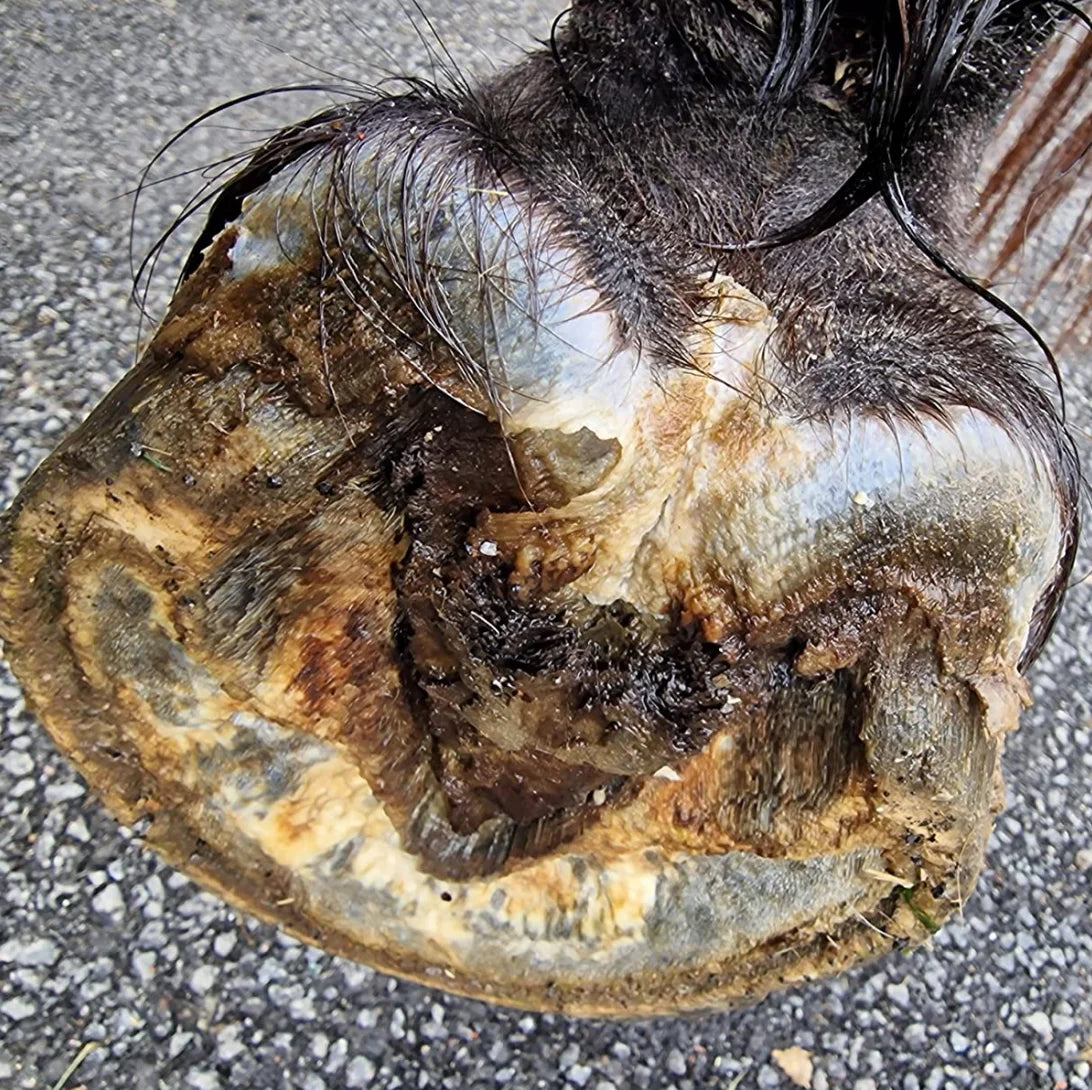
If the frog is already severely damaged, action should be taken quickly.
Not every case of thrush progresses in the same way. While early changes are often still limited to small areas of the frog, untreated thrush can worsen significantly over time. If you have just discovered a severely damaged frog, it is understandable that you are worried.
With advanced or severe thrush, it is often no longer just the surface that is affected. The horn may become soft, large areas may detach, deep frog sulci may develop, and sensitive tissue may become exposed. Many horses then already react painfully or even become lame.
The longer these changes persist, the more difficult complete regeneration of the frog often becomes. That is why it is important to correctly assess serious warning signs and act systematically now.
In this guide, we show you how to recognize severe thrush, what commonly causes it, which mistakes many horse owners make, and what a sensible care plan can look like.

Olaf's advice for severe thrush
If the frog is bleeding, your horse is showing signs of pain, or is lame, you should not waste any more time on self-treatment attempts. Carefully clean the hoof, document its condition, and consult a veterinarian and a qualified hoof-care professional.
Olaf and the Hoofgold team will help you recognize the warning signs and organize the next steps in this guide. You do not have to assess a severe case on your own.
How can you recognize severe thrush?
Advanced thrush often shows several of the following warning signs at the same time:
- Strong foul odor
- Large black or dark brown areas
- Soft or crumbling frog horn
- Deep central sulcus
- Large horn pockets
- Open sores
- Bleeding
- Pain reactions during cleaning
- Lameness or sensitivity
What is severe thrush?
Severe or advanced thrush is when you no longer see only superficial changes, but larger areas of the frog are already damaged.
The horn loses its natural stability, becomes soft and brittle, or partially disintegrates. Deep sulci can extend far between the bulbs, permanently trapping dirt, moisture, and dead horn.
In severe cases, the damage extends into more sensitive tissue layers. This can lead to pain, bleeding, and later even lameness.
For this reason, do not regard advanced thrush merely as a “dirty hoof.” The sooner you have the condition properly assessed, the better you can often prevent further deterioration.

The most important warning signs of severe thrush
Not every horse shows all symptoms at the same time. The more of these warning signs you notice, the more likely advanced changes in the frog are.
Strong foul odor
An intense, unpleasant odor is one of the most common signs of advanced thrush. While early changes may sometimes smell only slightly, the odor in severe cases is often noticeable immediately after lifting the hoof.
Large black areas
Dark deposits alone do not necessarily indicate thrush. In severe cases, however, large parts of the frog are often dark, greasy, or already partially disintegrated.
Soft or disintegrating horn
Healthy frog horn feels firm and elastic. In advanced thrush, however, the horn may feel soft, crumbly, or spongy. In some cases, it is already coming away in larger pieces.
Deep central sulcus
A deep central sulcus is one of the most important warning signs. The deeper this groove becomes, the more difficult it is to keep it clean, dry, and easy to monitor.

Large horn pockets
Larger cavities can form beneath loose horn. These pockets often remain permanently damp, quickly become dirty again, and make targeted care more difficult.
Bleeding
Hoof horn itself does not bleed. If blood becomes visible, sensitive tissue has usually been affected or injured. This condition should no longer be treated solely on your own.
Pain reactions
Many horses begin to pull their hoof away during cleaning, show clear sensitivity, or react to pressure in the area of the central sulcus.
Lameness
Not all lameness is caused by thrush. However, severe thrush can become so painful that the horse relieves pressure on the affected hoof. Lameness should always be evaluated by a veterinarian, as other conditions may also be involved.

What does severe thrush look like?
Advanced thrush can often already be recognized with the naked eye. Unlike in the early stage, the changes are no longer limited to small areas. The horn loses its natural structure, becomes soft and irregular, and is partly destroyed.
However, the condition should never be assessed based on color alone. Black horn by itself does not necessarily mean severe thrush. Only the combination of horn quality, odor, the depth of the central sulcus, sensitivity, and progression allows for a realistic assessment.
Image 1 – Healthy frog
A healthy frog has an even surface, firm horn, clearly visible sulci, and no unpleasant odor.

Image 2 – Early changes
Here, you can see the first dark deposits, a slightly deeper central sulcus, and smaller areas of softer horn.

Image 3 – Moderate thrush
The horn begins to break down more extensively. The central sulcus becomes deeper, black material accumulates persistently, and the odor becomes noticeably stronger.

Image 4 – Severe thrush
In severe cases of thrush, large parts of the frog may be destroyed. Deep cracks in the horn, open areas, pain, and occasional bleeding are possible.

Why does thrush become so severe?
Severe thrush usually does not develop within just a few days. In most cases, the condition worsens gradually over a longer period. This is not meant to blame you, but to show why regular checks and early action are so important.
The actual cause is often not a single trigger, but several factors occurring at the same time.
1. Early signs are ignored
At first, you may notice only a slight odor or some dark horn. Since your horse is not yet lame, the condition can easily be underestimated.
2. Persistent moisture
Wet paddocks, dirty stalls, or consistently damp living conditions make it difficult for the frog to regenerate.
3. Deep frog grooves
Narrow central frog grooves can permanently trap dirt, moisture, and dead horn. This makes care considerably more difficult.
4. Hoof care that is too infrequent
If loose horn areas, deep pockets, or unfavorable hoof shapes remain, thrush can continue to spread.
5. Random internet tips
If you try different home remedies one after another without changing the underlying cause, valuable time may pass. In the case of a severe condition, use a professionally coordinated approach early on.
What should you do now?
If your horse already shows advanced thrush, a systematic approach is more important than hastily trying out new products.
1. Stay calm
Not every severe change means that the hoof will remain permanently damaged. The sooner the right action is taken, the better the chances often are.
2. Clean the hoof thoroughly
Carefully remove manure, stones, and dirt so that the condition can be properly assessed at all.
3. Take photos
Photograph the hoof from several angles. This makes it possible to assess its progress more objectively.
4. Do not cut deeply yourself
Loose horn areas must not be removed without proper control. This should be handled by a hoof-care expert, especially in cases of bleeding or sensitive tissue.
5. Seek professional advice
An experienced hoof care professional or veterinarian can assess which areas need treatment and which structures should remain healthy.
6. Start a consistent care plan
A single product is rarely enough. Cleaning, targeted care, management, and regular monitoring always go hand in hand.
Which Hoofgold products are suitable for which step?
Each product serves a different purpose. Therefore, the question should not be “Which product is the strongest?” but rather “Which step do I need to take next?”
1. HCE hoof cleaner
The first step is to clean the hoof thoroughly so that the affected areas become visible and accessible.
 View HCE hoof cleaner
2. BlueStuff
After cleaning comes targeted care of the affected frog areas. BlueStuff is intended for exactly this step.
 View BlueStuff
3. Hornpads
With deep central frog grooves, Hornpads can help apply suitable care products in a controlled manner to hard-to-reach areas.
However, they do not replace thorough cleaning or professional assessment.
 View Hornpads
4. Hufkur
If poor horn quality is also present, general hoof support can also be provided in the long term.
Hufkur does not replace local treatment, but it is part of a long-term hoof care plan.
 View Hufkur
Which product serves which purpose?
| Problem | The appropriate step | Hoofgold Solution |
|---|---|---|
| Dirty hoof | Cleaning | HCE Hoof Cleaner |
| Affected frog areas | Targeted care | BlueStuff |
| Deep central sulcus | Hard-to-reach areas | Hornpads |
| Weak horn quality | Long-term support | Hufkur |

The most common mistakes with severe thrush
Treating only the odor
Less odor does not automatically mean that the frog has already regenerated.
Using too many products at the same time
Using several products at the same time often makes it difficult to assess which measure was actually helpful.
Not changing the cause
If the hoof remains permanently damp or dirty, thrush can recur despite good care.
Stopping too early
Even if the odor decreases, the development of the horn should continue to be monitored regularly.
When should a veterinarian be consulted?
Not every case of thrush requires immediate veterinary treatment. However, advanced thrush has warning signs that should no longer be assessed solely as part of normal hoof care.
The earlier serious changes are detected, the better possible consequential damage can often be limited.
Bleeding
Horn itself cannot bleed. If blood is visible, this generally means that sensitive tissue has been affected or injured. In this case, further experimentation should be avoided.
Lameness
Lameness should always be taken seriously. It can have various causes and should be evaluated by a veterinarian, especially if it occurs together with severe thrush.
Severe pain
If the horse reacts even when the hoof is gently cleaned or noticeably relieves weight from the hoof, this indicates greater involvement of sensitive structures.
Very deep central sulcus
If the central sulcus extends far between the bulbs and is barely visible, it should be professionally assessed.
No improvement
If there is no noticeable improvement over a longer period despite consistent cleaning, care, and optimized management conditions, or if the condition continues to worsen, the hoof should be re-examined.
Suspected other conditions
Not every change in the frog is automatically thrush. Other conditions can cause similar changes. An unclear diagnosis should therefore always be professionally assessed.
Hoofgold practical tip
Olaf's practical tip: With a severe case, it is not the strongest product that matters, but a clear sequence: clean carefully, have the depth and condition of the tissue professionally assessed, provide targeted care, and address the causes at the same time.
In practical hoof work, I often see that people waited too long because an initial change looked like a little dirt or the horse was not yet lame. That is precisely why you should take bleeding, pain, deep grooves, and crumbling horn seriously now.
Check the progress regularly and work closely with your veterinarian and hoof-care professional. This gives the frog the best possible conditions for stabilizing, without putting sensitive tissue under further strain through additional attempts at self-treatment.

Frequently asked questions about severe thrush
Can severe thrush heal again?
Yes. How well the frog regenerates depends, among other things, on how far the changes have progressed, whether the causes are eliminated, and how consistently care is provided.
Is blood normal with thrush?
No. Horn itself does not bleed. Blood indicates that sensitive tissue is involved and should be professionally assessed.
Can my horse become lame because of thrush?
Yes. Severe thrush can be painful. However, lameness should always be assessed by a veterinarian, as other causes may also be involved.
How long does healing take?
This depends on the severity, hoof trimming, living conditions, and consistent care. A severely damaged frog needs significantly longer than an early-stage change.
Can the frog grow back completely?
Frog horn grows continuously. How fully the frog regenerates depends on the extent of the damage and subsequent hoof care.
Does the frog need to be trimmed?
Loose or undermined horn areas can be professionally treated, depending on the findings. However, this should not be done uncontrolled on your own.
When should the veterinarian come?
In cases of bleeding, lameness, severe pain, swelling, open tissue defects, an unclear diagnosis, or no improvement.
Can thrush develop into hoof cancer?
Not every case of severe thrush develops into hoof cancer. Since some changes can look similar, unclear or unusual findings should be professionally evaluated.
Which products help with severe thrush?
The product selection depends on the respective care step. Cleaning, targeted frog care, treatment of deep frog grooves, and long-term hoof support serve different purposes.
Can I continue riding my horse?
This depends on the condition of the hoof and, in particular, whether pain or lameness is present. If in doubt, this should be discussed with a veterinarian or hoof expert.
Is thrush contagious?
Thrush is not considered a classic contagious disease. However, damp and unhygienic living conditions can increase the risk for multiple horses.
Why does thrush keep coming back?
The underlying causes often remain, such as persistent moisture, deep frog grooves, inadequate hoof trimming, or insufficient cleaning.
Recognize severe thrush early and take consistent action
You are not alone with a serious hoof problem. Advanced thrush usually does not develop overnight. It often develops from small changes that initially seem harmless.
By checking the hoof regularly, responding early, and following a structured care plan, you can significantly reduce the risk of further deterioration.
Sustainable improvement always consists of several components:
- Regular checks
- Thorough cleaning
- Targeted frog care
- Optimized living conditions
- Suitable hoof trimming
- Long-term support for horn quality
This gives the frog the best conditions to develop healthily again over the long term. Olaf and the Hoofgold team support you with practical knowledge and suitable care solutions - but they do not replace the necessary professional examination in cases of pain, bleeding, or lameness.
Discover Hoofgold frog care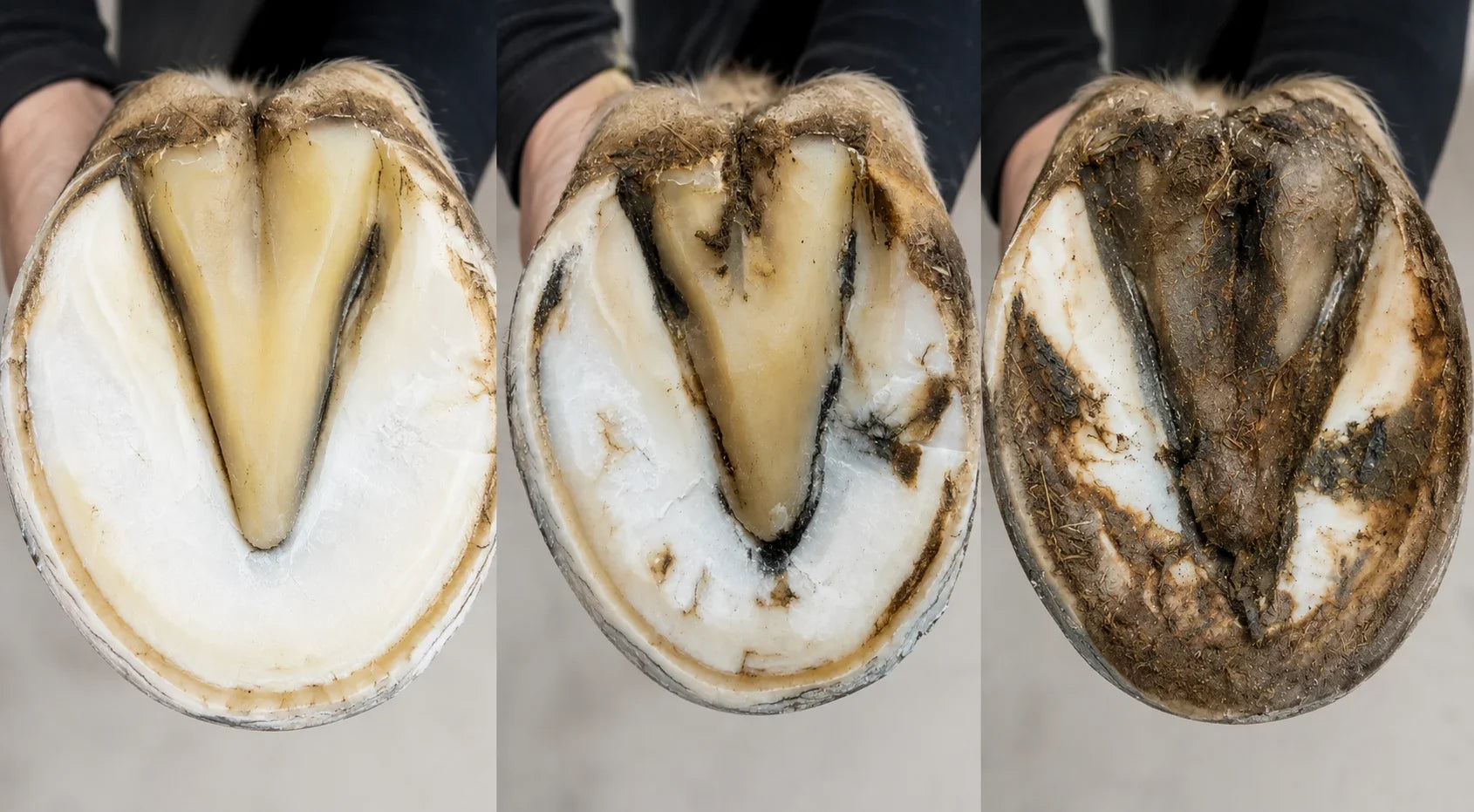
Share:
Which treatment for thrush is effective?
Treating thrush: Step-by-step guide for horses