
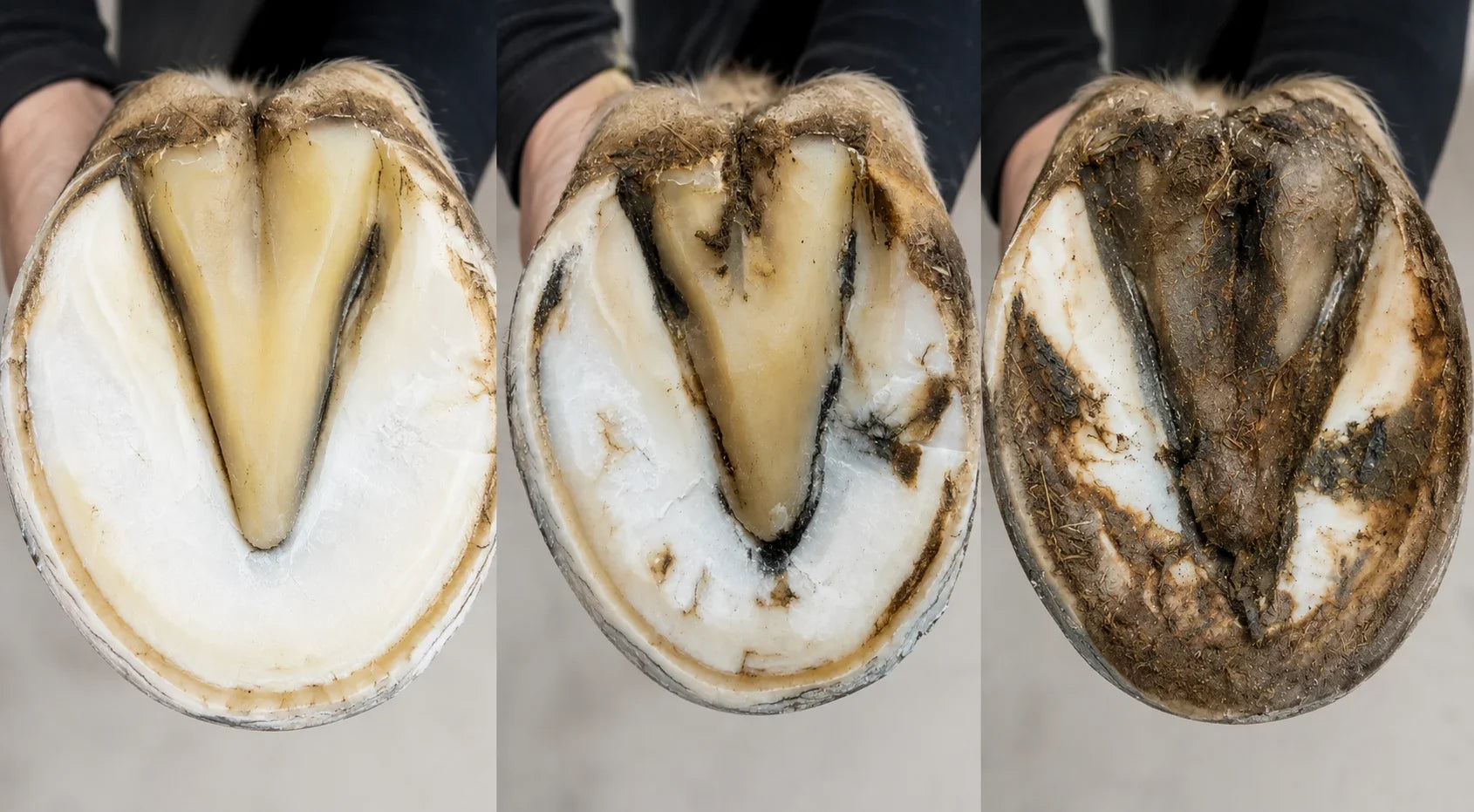
Visual guide to assessing the horse's hoof
Thrush does not look the same in every horse. You may first notice an unpleasant odor. In other horses, you may see a deep central frog sulcus, soft horn or dark, smeary deposits.
Especially in the early stages, the frog may still appear relatively unremarkable externally. Therefore, it is not enough to look only for a black spot. To recognize thrush in a horse, you should assess odor, horn quality, sulcus depth, sensitivity and changes over several days together.
This visual guide shows you which features indicate a healthy frog, what early and advanced changes may look like, and when you should seek professional help.

Olaf's note on image assessment
A good hoof image shows more than just the noticeable area. Photograph the hoof cleanly and from fixed, repeatable angles. This is the only way to compare changes meaningfully later and assess them more effectively together with your hoof-care professional.
In this visual guide, Olaf and the Hoofgold team show you what to look out for when examining and photographing the hoof. Olaf's personal photo and his detailed practical tip appear further down in the professional assessment section.
How can you recognize thrush in a horse?
Typical signs of thrush include:
- a notably foul or pungent odor,
- black, dark or smeary material,
- soft, brittle or crumbling frog horn,
- very deep or narrow frog sulci,
- loose horn flaps with moist pockets underneath,
- Sensitivity when picking out or touching the hoof,
- Bleeding, pain or lameness in severe cases.
What does a healthy frog look like on a horse?
The frog is located on the underside of the horse's hoof. It is usually V-shaped and bordered by the collateral sulci and the central sulcus.
A healthy frog can vary in width, length, and shape depending on the horse. Nevertheless, there are several characteristics that typically indicate a healthy structure.
Characteristics of a healthy frog
- The horn feels firm while also being slightly elastic.
- The surface is not slimy or mushy.
- There is no strong, foul odor.
- The sulci are accessible for inspection and not filled with deposits.
- The frog has no deep, dark, and moist pockets.
- The horse does not react painfully to gentle touch.
- No bleeding or open, sensitive areas are visible.
Some loose or detaching horn material is not automatically a sign of disease. Old horn can detach as part of the normal horn-shedding process. What matters is how the horn underneath looks and smells.


What does thrush look like in its early stages?
In the early stage, extensive destruction is often not yet visible. The first changes often occur in a single frog sulcus or beneath a small loose area of horn.
Image feature 1: Dark deposits in a sulcus
Dark material alone is not proof of thrush. Soil and manure can look similar. The deposit becomes suspicious if it appears slimy, smells unpleasant, and reappears shortly after cleaning.

Image feature 2: Soft or brittle horn
Individual areas of the frog may become softer and easier to rub away. This often creates an irregular or frayed surface.

Image feature 3: Deep central sulcus
A deep central sulcus can extend like a narrow cleft between the heel bulbs. Even if the visible surface still appears relatively healthy, moisture and damaged horn can accumulate deep in the sulcus.

Image feature 4: Small horn flaps or pockets
Moist pockets can form beneath loose horn. If dark, foul-smelling, or greasy material repeatedly remains underneath, the area should be assessed by a hoof-care professional.

You can find a detailed explanation of the first warning signs later via the internal link: Recognizing thrush in its early stages .
What does advanced thrush look like?
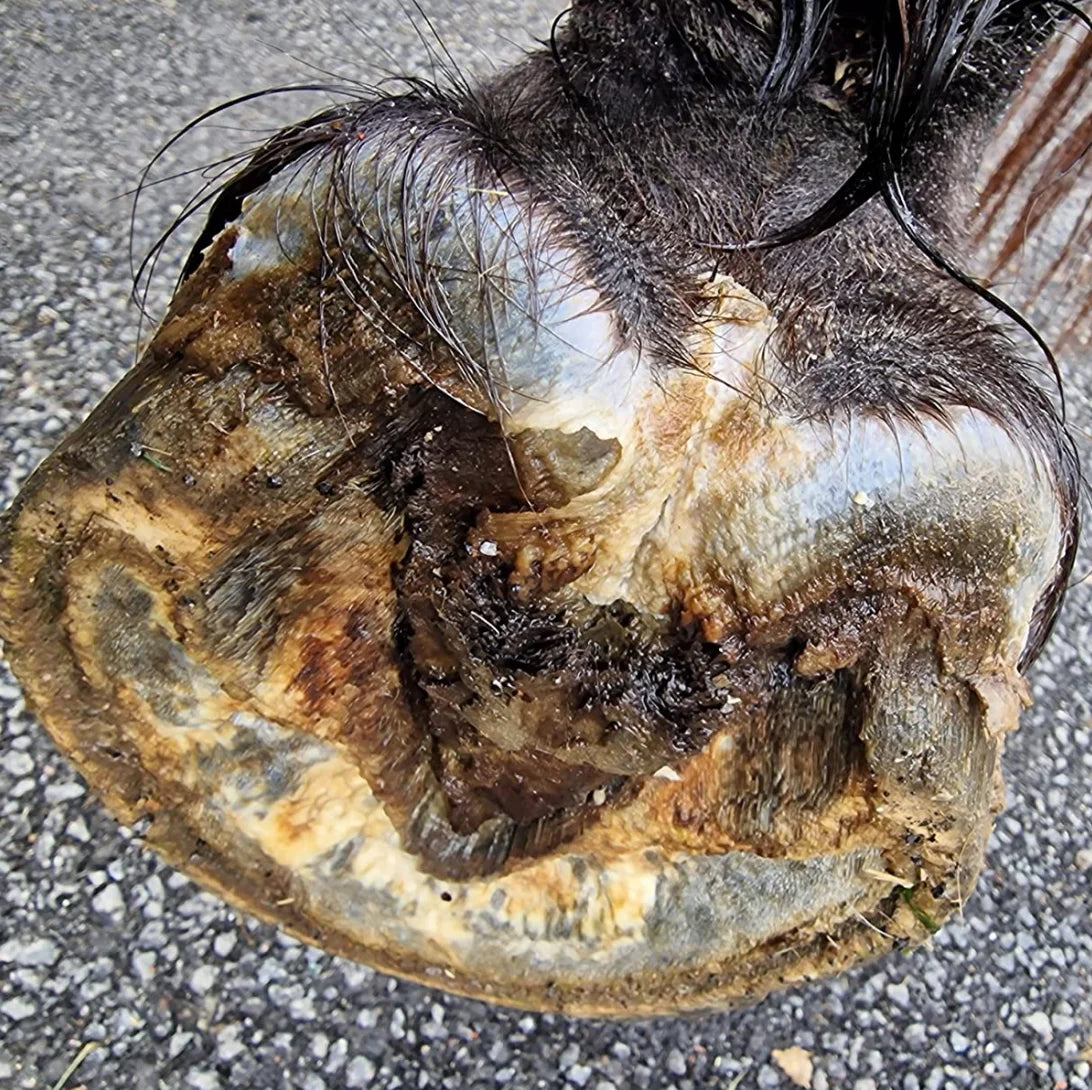
In advanced thrush, the frog horn is more severely damaged. The structure may be irregular, deeply fissured, or partly destroyed.
Typical visible changes
- black or very greasy material,
- large areas of soft or disintegrating horn,
- deep cracks extending between the bulbs,
- clearly missing or undermined horn areas,
- open or sensitive areas,
- possible bleeding,
- Pain reactions upon gentle touch.


You can find more information later in the guide: Severe thrush in horses: warning signs and the right approach .
How to correctly assess thrush symptoms
Pictures are helpful, but they do not show all the important clues. Some symptoms are easier to smell, feel, or recognize from the horse's behavior.
Odor
A distinct, foul or pungent odor is a common warning sign. It may be present before major damage becomes visible.
Horn texture
Healthy horn is firm. Affected horn may become soft, greasy, brittle, or easy to crumble.
Moisture
A single groove that becomes moist and dark again shortly after cleaning should be checked more closely.
Sensitivity
In the early stages, many horses do not yet react visibly. With deeper damage, the horse may pull its hoof away or avoid being touched.
Gait
Advanced and painful changes can cause sensitivity or lameness. However, lameness can also have other causes and should be professionally assessed.
Assessing the central frog groove in photos
The central frog groove is one of the most important areas to assess. A healthy groove is normally easy to monitor and does not form a deep, closed cleft.
Unremarkable central frog groove
- relatively open,
- visible and easy to monitor,
- not persistently damp,
- no greasy deposits,
- no pain response.
Suspicious central frog groove
- very narrow and deep,
- extends far between the bulbs,
- repeatedly contains dark material,
- smells unpleasant,
- is damp or sensitive.

The frog is coming loose: Is this already thrush?
Horn that is coming loose can be normal. The frog renews itself, and older horn layers may detach.
This is more indicative of normal horn shedding
- The underlying horn is firm.
- The area has no unusual odor.
- There is no deep, damp pocket underneath.
- The horse does not react sensitively.
- A stable horn surface appears after separation.
This is more indicative of a problematic change
- The underlying horn is soft or greasy.
- The pocket smells foul.
- Dark deposits form repeatedly.
- The area is becoming increasingly deep.
- The horse shows a pain response.

Healthy frog and thrush in direct comparison
| Characteristic | Healthy frog | Early thrush | Advanced thrush |
|---|---|---|---|
| Odor | Unremarkable | Slightly unpleasant | Clearly foul or pungent |
| Horn | Firm and elastic | Soft in places | Greasy, brittle, or crumbling |
| Grooves | Open and easy to monitor | Deep or repeatedly damp | Very deep, narrow, or severely damaged |
| Deposits | Normal dirt | Dark material returns | Black, greasy material |
| Sensitivity | None | Possibly mild | Clearly possible |
| Bleeding | No | Normally no | Possible with deep damage |
| Gait | Unremarkable | Usually unremarkable | Possible sensitivity or lameness |
How to photograph a horse's hoof for monitoring progress
Good photos help you assess changes over several weeks more objectively. Blurry images taken from changing perspectives, on the other hand, are difficult to compare.
Please photograph the hooves clean, brightly lit and without strong shadows. During each progress check, take the same three photos: first the view from below, then a combined view from the front and rear, followed by a combined view from both sides.
- Clean the hoof carefully before taking photos.
- Photograph the underside of the hoof first.
- Combine the front and rear views in one image.
- Combine the inner and outer sides in one image.
- Use bright, even lighting.
- Avoid strong shadows over the sulci.
- Always take photos from approximately the same distance.
- Also take a close-up of the affected sulcus.
- Note the date and the affected hoof.
- Compare the images at weekly intervals.


Recommended image file names
pferdehuf-verlauf-unten.webppferdehuf-verlauf-vorne-hinten.webppferdehuf-verlauf-seiten.webpgesunder-strahl-pferd.webpstrahlfaeule-anfangsstadium-pferd.webpstrahlfaeule-pferd-bilder.webptiefe-mittlere-strahlfurche.webpstrahlfaeule-vs-gesunder-huf.webpschlimme-strahlfaeule-pferd.webp
What should you do if the hoof looks like it has thrush?
A suspicious finding should not be ignored. At the same time, it is important not to trim aggressively or use strong home remedies based solely on a photo.
- Clean the hoof carefully and thoroughly.
- Take a photo of the initial condition.
- Check the smell, crevice depth and horn quality.
- Keep the hoof as dry as possible.
- Check the horse's living conditions and soiled ground areas.
- Consult a hoof-care professional for deep crevices.
- Begin a suitable care routine based on the actual findings.
You can find the complete procedure in the supplementary article: Treating thrush: step-by-step guide.
When should the findings be professionally assessed?
Images can provide initial guidance but cannot replace a complete examination. A veterinarian, farrier, or qualified hoof-care professional should be consulted if any of the following signs are present:
- The hoof is clearly painful to the touch.
- The horse is sensitive on its feet or lame.
- The groove extends deep between the bulbs.
- Bleeding occurs.
- The hoof is warm or swollen.
- Abnormal or proliferating tissue is growing.
- The condition is getting worse despite care.
- It is unclear whether thrush or another condition is present.
In particular, distinguishing thrush from hoof cancer, injuries, hoof abscesses, or White Line Disease should be left to professionals when findings are unclear.
Hoofgold practical tip
Olaf's practical tip: When assessing the hoof, never look only at its color. Dark horn can be caused by dirt, moisture, or natural pigmentation.
The combination of the following is more informative:
- Odor,
- Horn firmness,
- Depth of the frog grooves,
- Moisture,
- Sensitivity and
- Changes over time.
After more than 35 years of practical hoof care, it has become clear time and again that high-quality comparison photos are particularly useful when combined with a thorough examination of the entire hoof. The four standard views help you and your hoof-care professional compare changes more reliably.

Frequently asked questions about recognizing thrush
What does thrush look like in horses?
Dark or greasy material, soft frog horn, deep frog grooves, and loose horn areas are often visible. In advanced cases of thrush, more extensive horn damage, bleeding, and sensitive tissue may become visible.
What color is thrush?
Affected areas often appear dark brown to black. However, color alone is not enough for assessment, as soil, manure, and natural pigmentation can also look dark.
What does thrush smell like?
A foul, pungent, or unusually unpleasant odor is typical. It may be noticeable before major horn damage becomes visible.
Can thrush occur without a black frog?
Yes. In the early stages, only soft horn, a deep groove, or a slight unpleasant odor may be noticeable.
Is dark material in the hoof always thrush?
No. Dirt and manure can also be dark. Material that is slimy, has a strong odor, and quickly forms again after cleaning is more suspicious.
How can thrush be distinguished from normal horn wear?
Normal loose horn usually covers firm, dry, insensitive horn. With thrush, moist, foul-smelling, dark, or painful pockets may lie underneath.
Is a deep central frog groove already thrush?
Not automatically. However, it is a risk area because it is difficult to keep clean and dry. Smell, buildup, and sensitivity must also be assessed.
Can thrush be diagnosed reliably from a photo?
A photo can provide important clues, but it cannot fully show smell, horn firmness, pain response, or groove depth. If you are unsure, an in-person examination is advisable.
How often should I photograph suspicious areas?
A weekly comparison is often sufficient. Take photographs from the same perspective and in similar lighting whenever possible.
Can thrush bleed?
Horn itself does not bleed. Bleeding indicates that sensitive tissue has been reached or injured. The area should not be treated aggressively any further.
When does a veterinarian need to examine the hoof?
A veterinarian should be consulted if your horse is lame or has severe pain, bleeding, heat, swelling, deep lesions, unusual tissue growth, or an unclear diagnosis.
Not sure whether your horse has thrush?
You don't have to assess the findings alone. Don't compare only the color; also check the smell, horn firmness, depth of the grooves, and sensitivity. Document suspicious changes with the four fixed views and seek professional help if the findings are deep or painful.
Olaf and the Hoofgold team want to support you with clear, practical knowledge and suitable care solutions, so you can assess the next steps for your horse with greater confidence.
Discover Hoofgold frog care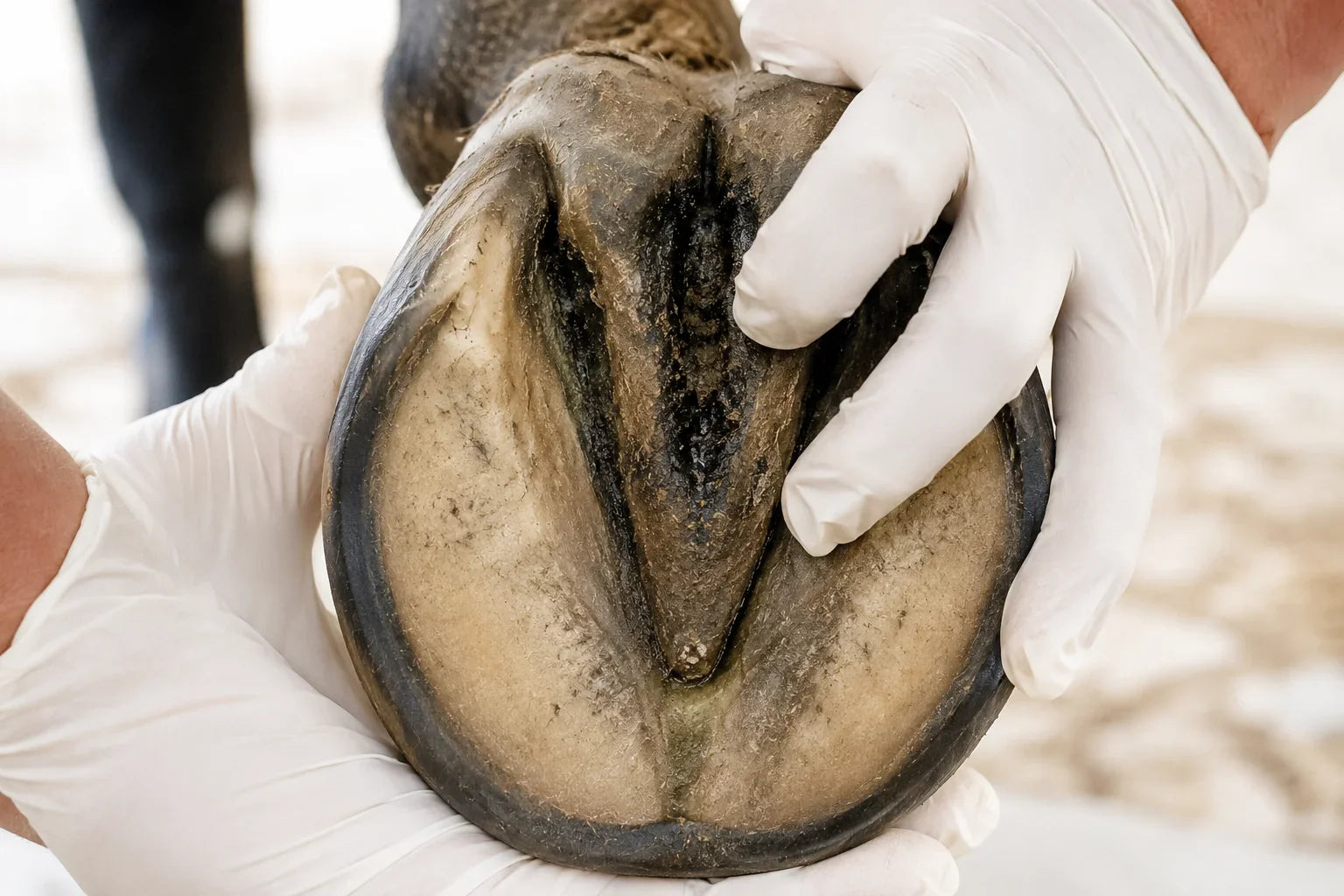
Share:
Treating thrush: Step-by-step guide for horses