
Practical treatment guide for horse owners
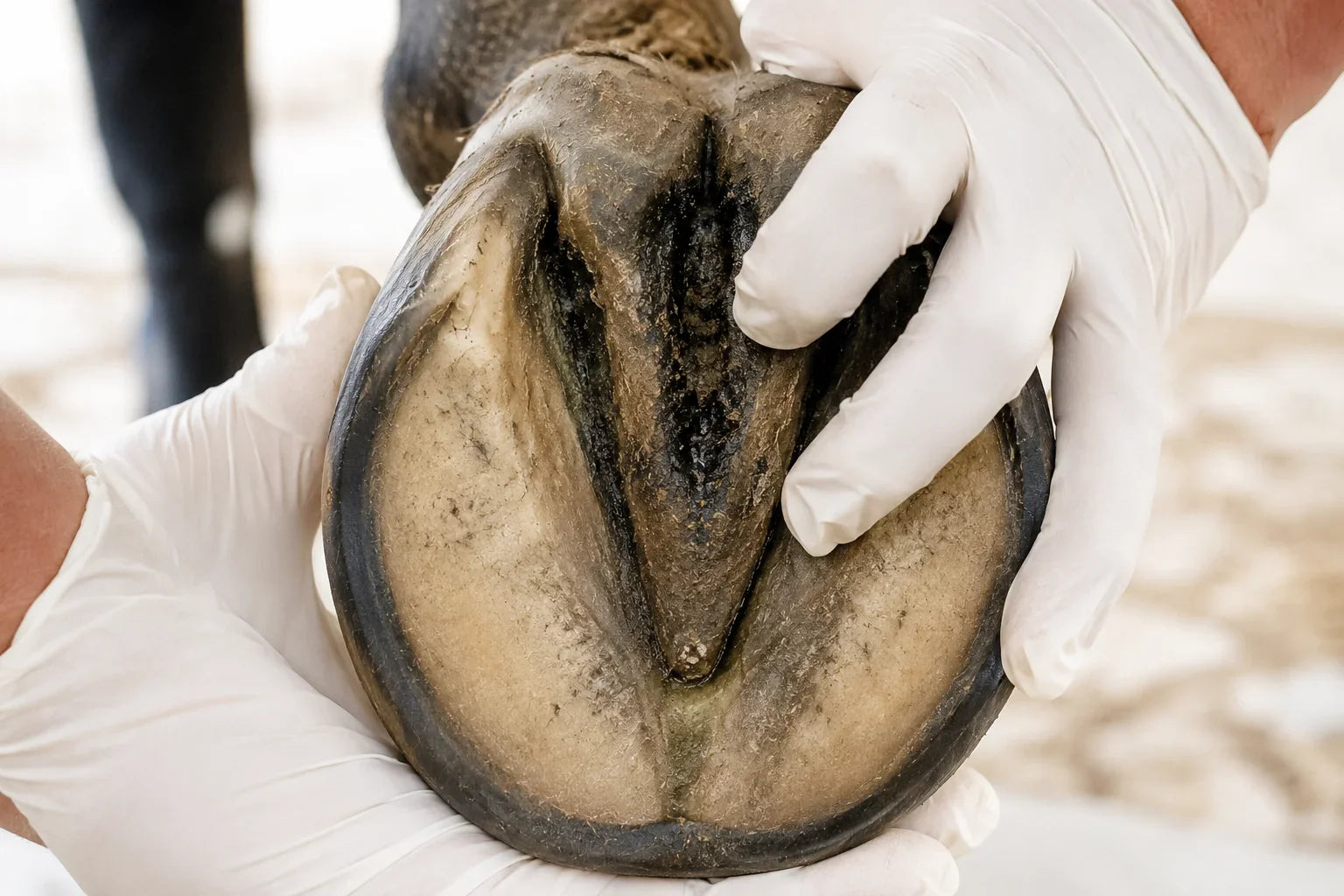
Does your horse's hoof smell unpleasant, has the frog horn become soft, or is dark, slimy material collecting in the frog grooves? Perhaps you are feeling uncertain right now - you are not alone. What matters now is not ignoring the change. Successful treatment does not consist merely of applying a product to the hoof.
To treat thrush in horses sustainably, you should make the affected areas accessible, clean them thoroughly, provide targeted care, and at the same time improve the conditions that cause it.
In this guide, we show you step by step how to proceed when dealing with thrush, which mistakes are commonly made, and when you should consult a hoof trimmer, farrier, or veterinarian.

A personal note from Olaf

If you want to treat thrush, it is not the strongest remedy that matters, but the right sequence. First assess the hoof carefully, clean the affected areas, and then address the causes specifically.
Olaf and the Hoofgold team will guide you step by step through this guide so that you can establish a calm and systematic care routine.
Treating thrush: The essentials at a glance
1. Assess the hoof:
Check depth, odor, horn quality, sensitivity, and possible bleeding.
2. Clean the hoof thoroughly:
Carefully remove dirt, manure, and loose debris.
3. Make the affected areas accessible:
If necessary, have loose or undermined horn removed by a qualified hoof-care professional.
4. Provide targeted care:
Apply a suitable product only to the prepared and preferably dry hoof.
5. Eliminate the causes:
Check moisture, soiled areas, deep grooves, lack of movement, and unsuitable hoof trimming.
6. Monitor progress:
Continue the treatment consistently and document changes with photos.
Before treatment: How severe is the thrush?
Before beginning treatment, you should assess how far the condition has progressed. A superficial, slightly foul-smelling sulcus requires different care than a deep, painful or bleeding crack.
Therefore, do not inspect only the visible surface, but also the central sulcus, the collateral sulci, the bulbs of the heel, and the adjacent sole.
Signs of a mild or early change
- Slightly unpleasant odor
- Soft hoof horn in individual areas
- Dark deposits in a sulcus
- Small loose areas of hoof horn
- No clear pain response
- No change in gait
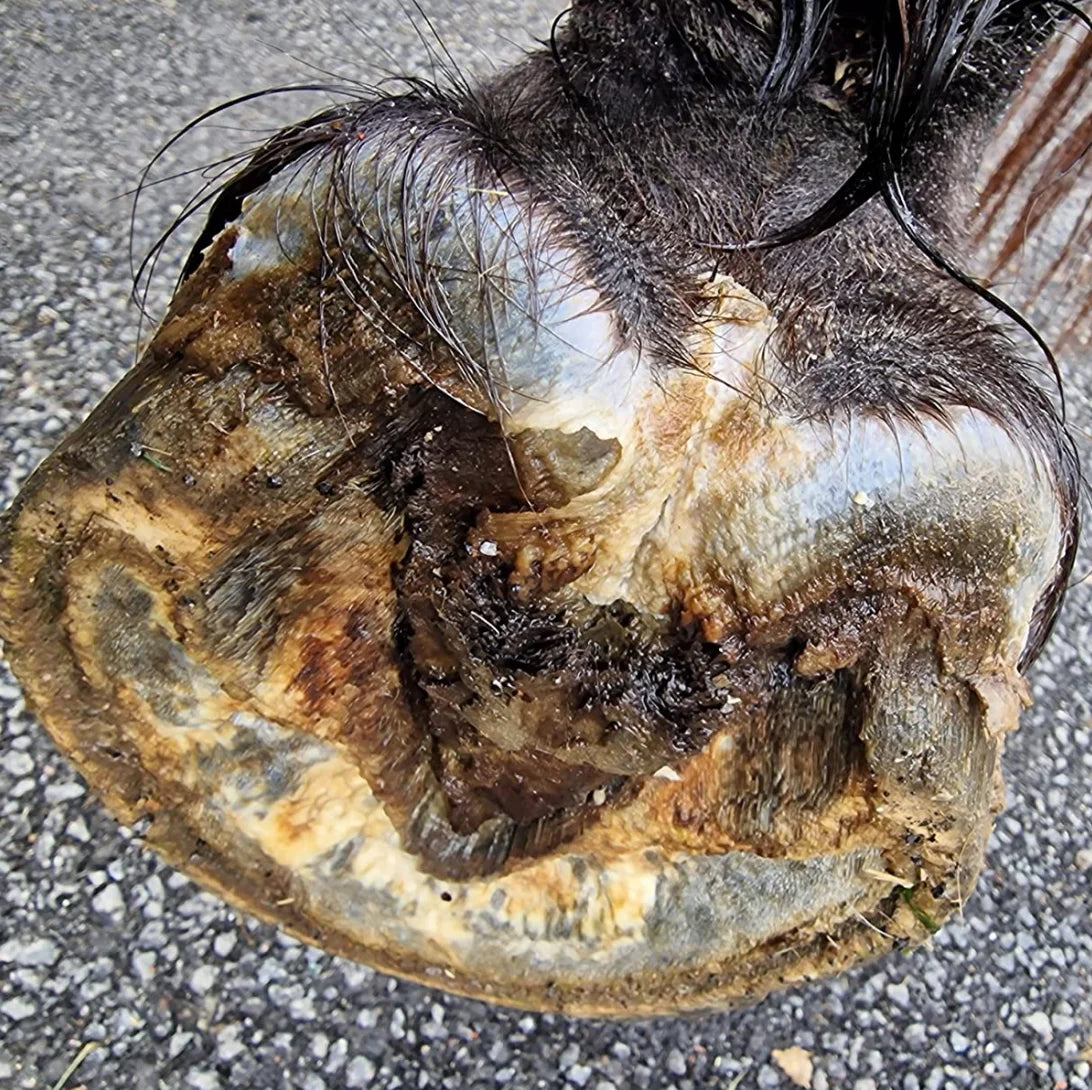
Signs of an advanced condition
- Very deep central sulcus
- Black, slimy or disintegrating material
- Strong foul odor
- Sensitivity when touched or scraped out
- Bleeding or visibly sensitive tissue
- Heat, swelling or lameness
Are you unsure whether it is actually thrush? Then first read our detailed guide Recognizing thrush in horses: causes, symptoms and treatment.
Step 1: Thoroughly inspect the entire hoof
Lift the hoof and first examine it as a whole. Successful treatment begins with a thorough assessment. If you treat only the dark area, you may miss deeper pockets, an unfavorable hoof shape, or other affected areas.
Pay particular attention to:
- The depth of the central sulcus,
- the lateral frog clefts,
- Loose or undermined areas of hoof horn,
- Narrow or compressed heels,
- Odor and moisture,
- Slimy or black deposits,
- Sensitivity to light pressure and
- Differences from the other hooves.
It is advisable to take a well-lit photo before beginning treatment. Photograph the hoof from directly underneath as much as possible. This will allow you to see later whether the central sulcus is opening up, the damaged material is decreasing, and stronger hoof horn is growing back.

Step 2: Carefully remove coarse dirt
First remove manure, soil, stones and firmly embedded deposits with a clean hoof pick. A stiff hoof brush can then be used to loosen surface dirt.
Work slowly and without applying strong pressure. With deep grooves in particular, there is a risk of touching or injuring sensitive tissue.
What you should avoid
- Do not forcefully poke deep into a narrow groove.
- Do not use sharp objects for self-treatment.
- Do not continue working on sensitive or bleeding tissue.
- Do not tear out detached pieces of horn in an uncontrolled manner.
Your goal in this step is to make the hoof visible and accessible. The actual treatment can only work where dirt and dead material do not block access.
Step 3: Make the affected horn areas accessible
Thrush can cause loose horn flaps, pockets or undermined areas to form. Moisture and organic material accumulate beneath them. If a product is merely applied to the closed surface, it may not reach the affected area.
Pathologically altered or loose horn may therefore need to be professionally removed. This step should be carried out by an experienced hoof trimmer, farrier or veterinarian.
How much horn may be removed depends on:
- how deep the alteration extends,
- whether the horn has already fully detached,
- whether sensitive tissue lies beneath it,
- whether pain or bleeding occurs and
- what the overall hoof balance looks like.

Step 4: Clean the hoof and dry it as much as possible
After removing the coarse dirt, you should thoroughly clean the affected area. This is not about soaking the hoof for a long time. Prolonged moisture can further soften the horn structure.
Clean the accessible grooves according to the selected care routine and carefully remove loosened deposits. The area should then be allowed to dry as much as possible before another care product is applied.
HCE Hoof Cleaner
It belongs in the preparatory cleaning phase, before targeted frog care takes place.
 View HCE Hoof Cleaner
Why drying is important
Deep, poorly ventilated and persistently damp frog clefts provide unfavorable conditions for stable frog horn. After cleaning, the horse should therefore preferably not be put straight back into heavily soiled mud or wet bedding.
In many management systems, moisture cannot be completely avoided. The important thing is that at least dry feeding, resting or turnout areas are available and that the hoof is checked regularly.
Step 5: Apply a suitable frog-care product specifically
After cleaning, apply the selected frog-care product specifically to the affected areas. Do not indiscriminately coat the entire hoof. The key is to reach the actual problem areas.
These often include:
- the central frog cleft,
- the lateral frog clefts,
- small pockets under loose horn and
- Transitions between the frog and sole.
Always follow the product instructions regarding quantity, frequency and duration of use. A larger amount or more frequent application is not automatically better.
Hoofgold BlueStuff
The recommendation should always be accompanied by thorough preparation and an analysis of the causes.
 View Hoofgold BlueStuff

Step 6: Properly care for deep frog clefts
A deep central frog cleft can be particularly persistent. The area is often narrow, poorly ventilated and difficult to keep clean. Dirt can become firmly lodged deep between the bulbs.
In such cases, applying a product only superficially may not be sufficient. Care must reach the affected area without sealing the cleft tightly or trapping contaminated material inside it.
What to bear in mind with deep clefts
- Have the cleft fully assessed first.
- Carefully remove dirt and loose material.
- Do not push unsuitable materials deep inside.
- Do not put pressure on sensitive areas.
- Check regularly that the area remains clean.
Hoofgold Hornpads
They should not be used simply to cover a dirty or unclear area.
 View Hoofgold Hornpads
Step 7: Repeat the treatment consistently
A single application is often not enough when thrush is present. Damaged horn needs time to separate, and more stable horn must grow out. So be patient with your horse and remain consistent with the recommended routine.
Therefore, check the hoof regularly and continue the care routine according to the product instructions and professional recommendation.
How to document progress
- Photograph the hoof before the first treatment.
- Use the same perspective for every image.
- Take photos in similar lighting whenever possible.
- Note the smell, moisture, and sensitivity.
- Compare the images weekly rather than daily.
Small daily differences are often difficult to notice. Comparing images over several weeks shows more clearly whether the sulci are opening, less dark material is forming, and more stable horn is becoming visible.

The cause must be addressed at the same time
Thrush can return if you treat only the visible area. A care product cannot resolve management, exercise, or hoof-trimming problems on its own. Therefore, look at the overall picture together with your hoof-care professional.
Moisture and stable hygiene
Remove wet or heavily soiled bedding regularly. Feeding and resting areas in particular should be kept as clean and dry as possible. On paddocks and in open stables, paved or drier areas can help.
Hoof trimming
Deep pockets, loose horn, contracted heels, or unfavorable hoof balance should be professionally assessed. The appropriate trimming interval depends on the individual horse and its horn growth.
Exercise
Regular, appropriate exercise supports the hoof's natural function. A horse that moves very little benefits less from the mechanical self-cleaning of the underside of the hoof.
General horn quality
If several hooves are affected or the horn generally appears soft, brittle, or slow-growing, overall hoof health should also be assessed.
Hoofgold Hufkur
It does not replace local frog care or any necessary adjustment to management, hoof trimming, or feeding.
 View Hoofgold Hufkur
How can you tell that the treatment is working?
Do not assess progress based on smell alone. It may fade relatively quickly even though the central sulcus has not yet stabilized.
Positive signs may include:
- The unpleasant smell decreases.
- Less black or slimy material forms.
- The hoof stays cleaner between checks.
- Sensitive areas are reacting less strongly.
- The central frog sulcus is becoming more open and drier.
- Firmer and more stable horn is growing in.
- No new loose pockets are forming.
Be encouraged by the first signs of progress, but do not focus only on a short-term visual improvement. The sustainable development of the frog structure is what matters.
When should treatment be reviewed?
If there is no noticeable improvement despite consistent care, the following should be checked:
- whether the affected area is actually accessible,
- whether the product is being used correctly,
- whether an underlying condition is present,
- whether hoof balance is hindering healing and
- whether the living conditions and moisture remain problematic.
The most common mistakes when treating thrush
Mistake 1: Applying the product to a dirty hoof
Dirt and loose horn can prevent the product from reaching the affected area.
Mistake 2: Treating only the surface
The visible dark area may be smaller than the actual change in a deep groove or pocket.
Mistake 3: Scraping or cutting too aggressively
Sensitive tissue can be injured. Opening up deep or undermined areas should be left to trained professionals.
Mistake 4: Ending treatment too early
Less odor does not automatically mean that the horn has already fully stabilized.
Mistake 5: Leaving the environment unchanged
If the hoof is placed back into contaminated, wet conditions every day, important causes remain.
Mistake 6: Always using stronger products
More aggressive or caustic substances are not automatically more effective. With deep changes, there is a risk of causing additional damage to sensitive tissue.
Mistake 7: Attributing lameness exclusively to thrush
Lameness can also be caused by hoof abscesses, injuries, White Line Disease, or other conditions.
When should a veterinarian or hoof-care professional be consulted?
Mild, superficial changes can often be managed as part of a consistent care routine. However, professional help should be sought if any of the following signs occur:
- The horse is lame or noticeably footsore.
- The affected area is bleeding.
- The change extends deep between the bulbs.
- The hoof is warm or swollen.
- Abnormal or proliferating tissue is growing.
- The condition worsens despite care.
- The thrush keeps coming back.
- The diagnosis is unclear.
It is particularly important to distinguish it from other hoof problems such as hoof cancer, White Line Disease, hoof abscesses, or injuries.
Hoofgold practical tip
Olaf's practical tip: Daily hoof care repeatedly shows that the care product alone rarely determines long-term success. Therefore, do not look only at the affected area, but at the entire hoof and your horse's living conditions.
The key is the combination of:
- professional hoof preparation,
- consistent and targeted care,
- appropriate hoof trimming,
- cleaner and drier living areas,
- sufficient exercise and
- enough time for healthy regrowth.
If you are unsure, you do not have to decide alone. The Hoofgold team and your hoof care professional can help you bring the individual elements together in a sensible way.

Frequently asked questions about treating thrush
What should you do if your horse has thrush?
The hoof should be checked, thoroughly cleaned and kept as dry as possible. Loose or undermined areas of horn may need to be removed professionally. Targeted care should then be provided according to the condition and the product instructions. At the same time, management, exercise and hoof trimming should be reviewed.
How often does thrush need to be treated?
The frequency depends on the product used and the severity of the condition. Follow the product instructions and your hoof care professional's recommendation. Regardless, the hoof should be checked regularly and kept clean.
How long does thrush treatment take?
Superficial changes may stabilize more quickly than deep grooves or damaged tissue. The odor may diminish early, while the regrowth of stable horn takes several weeks or longer.
Can thrush disappear on its own?
Minor changes may improve when conditions are significantly improved. However, it is risky to simply wait for this alone. If the groove remains damp, narrow or dirty, the damage may become deeper.
Do you have to cut out thrush?
Loose, dead or undermined horn may need to be removed to make the area accessible. This step should be carried out professionally to avoid injuring healthy or sensitive tissue.
Should you wash a hoof with thrush?
Cleaning may be appropriate. However, the hoof should then be allowed to dry as much as possible and not remain constantly wet. Prolonged soaking is not automatically beneficial.
What is the best treatment for thrush?
The right treatment depends on the treatment goal. Cleaning, targeted frog care, treating deep grooves and supporting overall horn quality are different steps. No product replaces professional hoof care and improving the horse's living conditions.
Can you continue riding with thrush?
That depends on the depth, sensitivity and the horse's gait. In cases of lameness, pain, bleeding or deep tissue damage, the horse should be professionally examined before further exercise.
Why does thrush keep coming back?
Recurring thrush often indicates that an underlying cause remains. These include deep grooves, contracted heels, moisture, dirty surfaces, little exercise or unsuitable hoof care.
When should a veterinarian be called for thrush?
A veterinarian should be consulted in cases of lameness, severe pain, bleeding, heat, swelling, deep changes, abnormal tissue growth or no improvement.
Can thrush bleed?
Healthy horn does not bleed. Blood indicates that sensitive tissue has been reached or injured. In this case, do not continue aggressive scraping or cutting.
Does exercise help with treatment?
Regular exercise suited to the horse supports the hoof's natural function. However, it does not replace local care and professional hoof care for existing thrush.
Building a systematic frog-care routine
You are not alone with this problem. Effective treatment combines cleaning, targeted care, professional hoof care and improving the underlying conditions.
At Hoofgold, we want to offer you not only suitable products but also the knowledge you need to assess the next steps for your horse more safely. If you have any questions, we are here to offer advice and support.
Discover Hoofgold frog care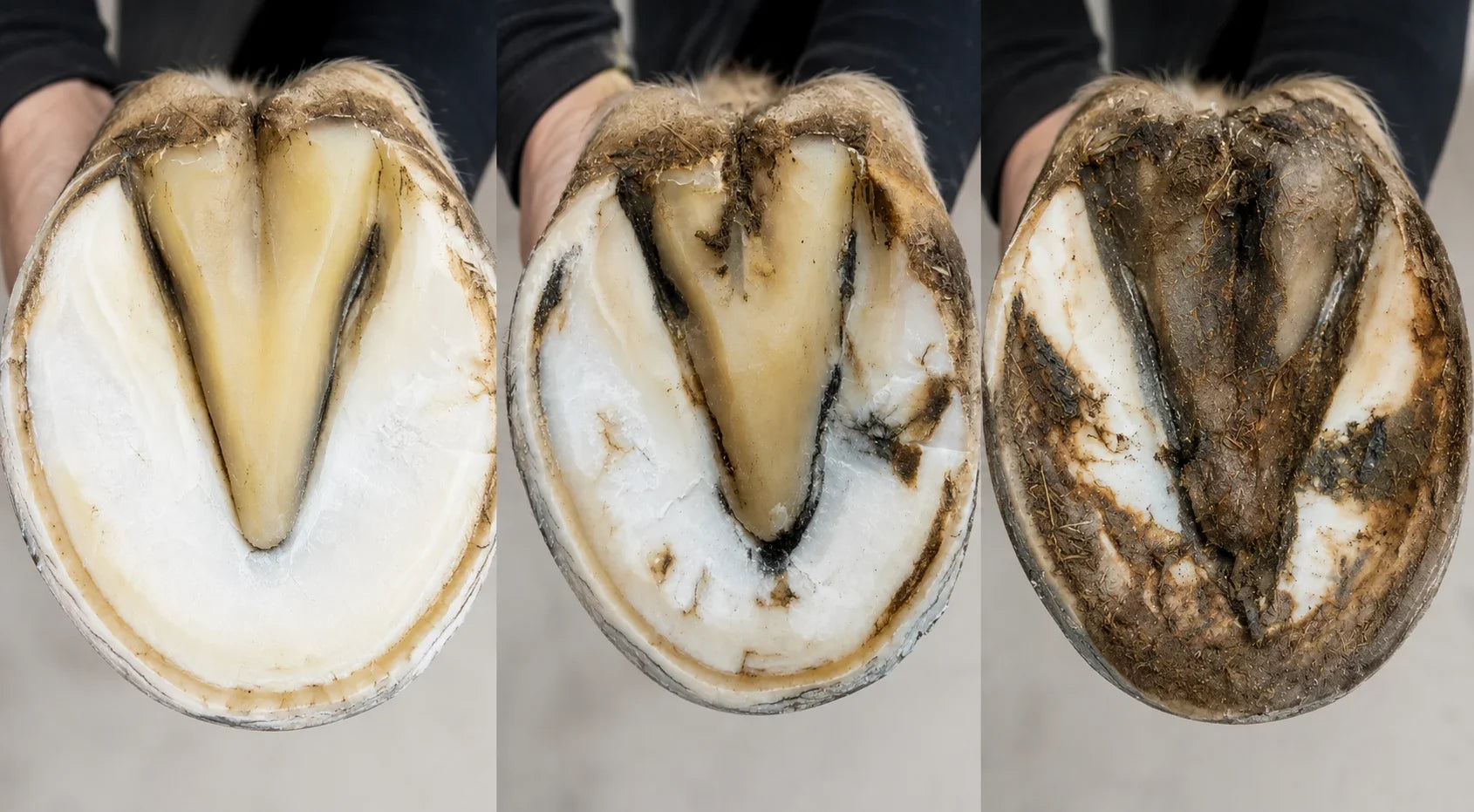
Share:
Severe thrush in horses: warning signs and the right approach
Recognizing thrush: pictures, symptoms, and differences from a healthy hoof