
Hoof knowledge from more than 35 years of practical experience
Have you noticed an unpleasant odor while picking out the hoof, or have you observed dark, soft horn and unusually deep collateral grooves? These may be signs of thrush in horses. Perhaps you are feeling uncertain right now - you are not alone. The earlier you recognize the change, the better you can prevent the damage from penetrating deeper into the frog and causing your horse pain.
In this guide, we will show you step by step how to recognize thrush, which causes are commonly behind it, what a sensible care routine can look like, and when you should involve a hoof care professional or veterinarian.

We're glad you're here

Hello, I’m Olaf Optenplatz. I have been working with horse hooves every day for more than 35 years. Together with our Hoofgold team, I have helped oversee more than one million hoof treatments during this time.
We know how worrying it can be when you suddenly discover a change in your horse's hoof. That is precisely why we share our practical knowledge with you: clearly, honestly, and concretely, so that you can assess the next steps with greater confidence.
You do not have to solve the problem alone. We at Hoofgold are here to support you with advice and practical help.
Thrush explained briefly
What is thrush?
The frog horn is damaged or decomposed, often in connection with colonization by microorganisms.
Typical signs:
Unpleasant odor, dark or slimy material, soft frog horn, deep grooves, and, in advanced cases, sensitivity to pain.
What is important now?
Carefully inspect and clean the hoof, keep it as dry as possible, ensure professional hoof care, and consistently follow a suitable care routine.
When does your horse need professional help?
In case of pain, lameness, bleeding, severely damaged horn, deep lesions, or no improvement, you should consult a veterinarian or qualified hoof expert.
What is thrush in horses?
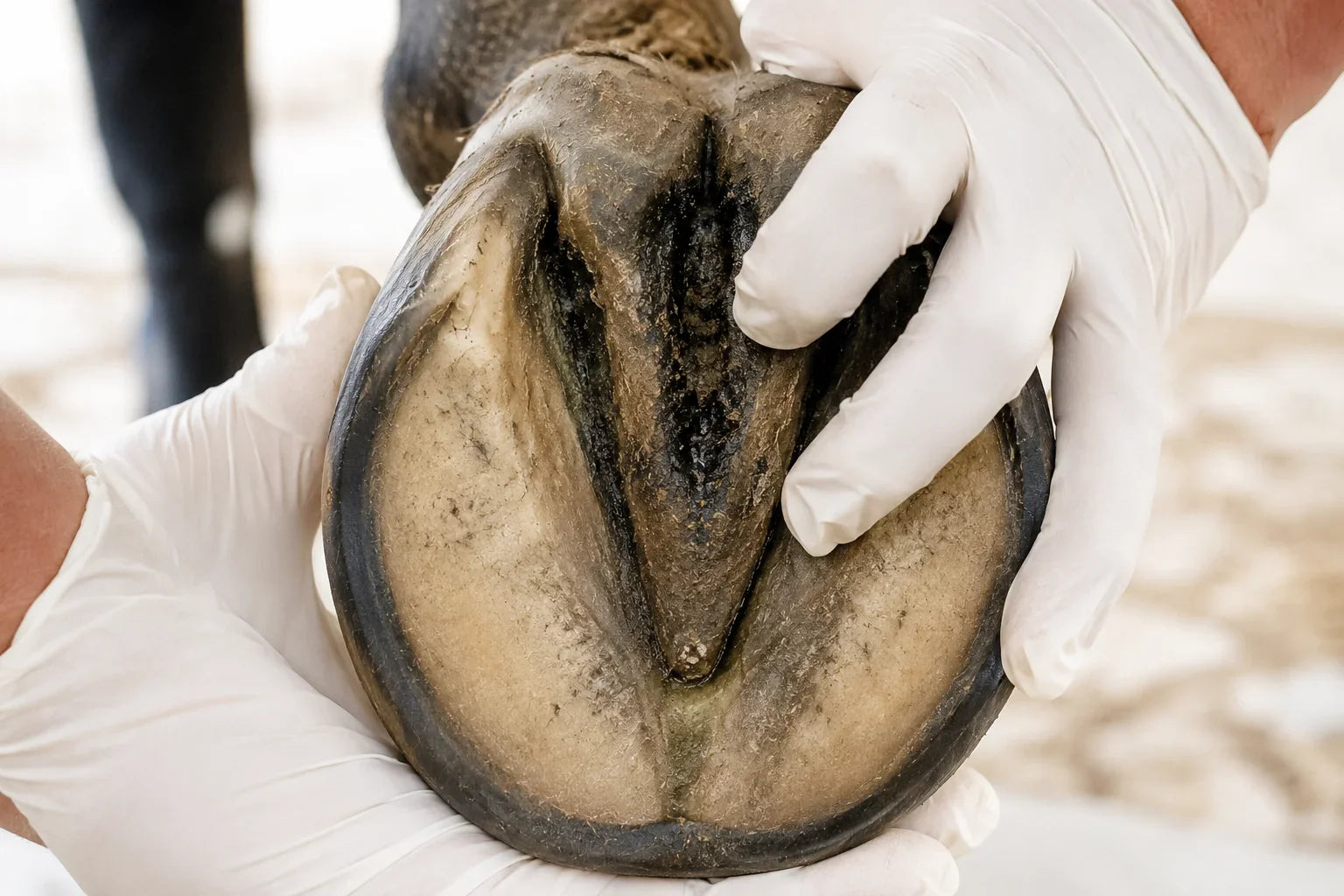
When you look at the underside of the horse's hoof, you can identify the frog as an elastic, usually V-shaped structure. It lies between the two collateral frog grooves and is divided by the central sulcus. A healthy frog should be resilient, elastic, and as free as possible of deep, poorly ventilated pockets.
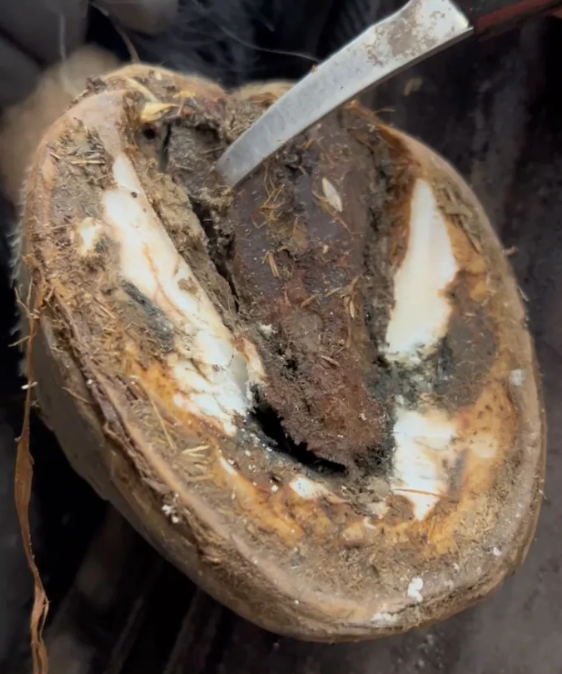
With thrush, the frog horn is damaged and breaks down. Dark, soft, or greasy material and a characteristic unpleasant odor may develop in the affected grooves. Narrow and deep frog grooves are particularly problematic because they retain moisture, dirt, and organic material.
Thrush is therefore not simply “some dirt in the hoof.” It shows you that the natural stability and protective function of the frog horn is impaired. If you recognize the change early, you can often counteract it with consistent hoof care, optimized management, and professional hoof trimming.
However, if the damage extends into sensitive tissue, the horse may show signs of pain. In such cases, an ordinary care routine is no longer sufficient. The cause must then be professionally assessed and an individual treatment plan developed.

Recognizing thrush: Which symptoms are typical?
You may also notice thrush during daily hoof picking. The earlier you notice changes, the sooner you can adjust management, hoof trimming, and care.
Early signs
- Unusually unpleasant or foul odor
- Softening frog horn
- Dark deposits in the frog grooves
- An unusually deep or narrow central sulcus
- Small pockets, cracks, or loose areas of horn
- Dirt that remains deeply lodged in the grooves despite picking out the hoof
Advanced signs
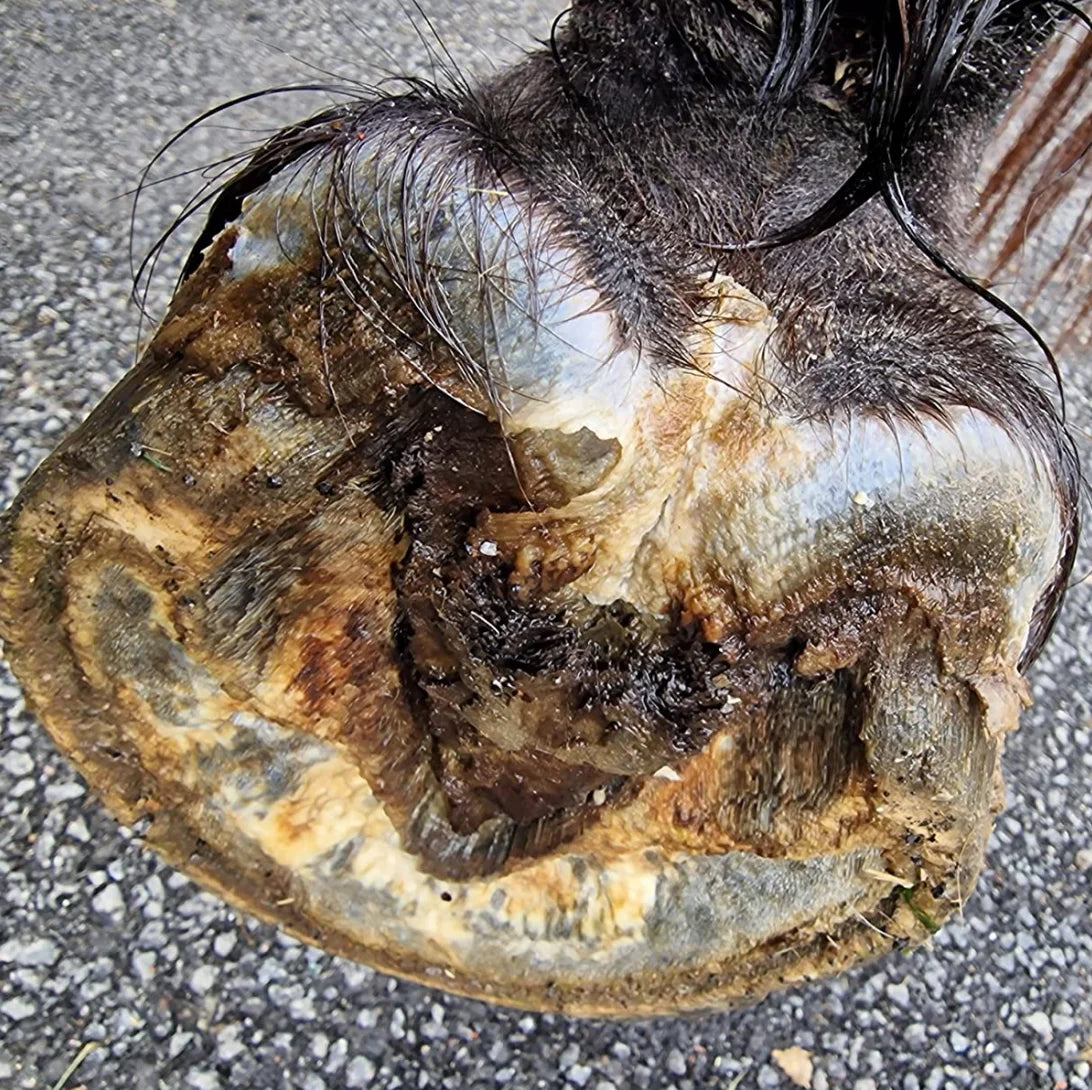
- Black, greasy, or disintegrating material
- Clearly damaged or missing areas of the frog
- Very deep cracks extending between the bulbs of the heel
- Sensitivity to touch or when picking out the hoof
- Bleeding from damaged tissue
- Altered gait or lameness
A horse can initially walk normally despite thrush. Therefore, the absence of lameness does not automatically mean that the hoof is healthy. Conversely, sudden or pronounced lameness should never be hastily attributed solely to thrush. Hoof abscesses, injuries, or other conditions can also cause pain in the hoof.

Thrush or normal horn wear?
Loose horn can regularly detach from the frog. This is not automatically pathological. Normal horn wear generally does not smell strongly rotten and does not necessarily leave soft, greasy or tender areas.
If you are unsure, loose horn should not be cut out deeply on your own. A qualified hoof-care professional or farrier can determine whether it is normal horn shedding, trapped pockets or pathologically altered tissue.
What does thrush look like in its early stages?
In the early stages, thrush is often inconspicuous. Your horse's frog may still appear largely intact on the outside, while the first changes are already developing deep within a frog groove. A close look is therefore always worthwhile.
Pay particular attention to:
- The central frog groove: Is it just a shallow depression, or does it extend as a narrow cleft far between the bulbs of the heel?
- The lateral frog grooves: Does dark, damp material repeatedly remain there?
- The odor: Does a noticeably unpleasant odor return shortly after cleaning?
- The horn quality: Is the frog firm and elastic, or soft, greasy and brittle?
- The horse's reaction: Does it pull its hoof away as soon as certain areas are gently touched?

If you respond early, small pockets or cracks are easier to keep clean and dry than deeply damaged areas. You can also check with your hoof-care professional in good time whether an unfavorable hoof shape, a narrow heel area or unsuitable hoof trimming is contributing to its development.
A detailed series of images and a more precise checklist will be covered later in the supplementary guide Recognizing thrush in its early stages.
Causes: Why does thrush develop in horses?
When your horse develops thrush, there is rarely just one cause behind it. Several factors often come together: moisture, insufficient natural self-cleaning of the hoof, deep frog grooves, trapped organic material and an already weakened horn structure.
1. Moisture and contaminated surfaces
Mud, wet bedding and surfaces contaminated with manure or urine create conditions in which the frog horn can remain permanently soft. It is particularly critical when the hoof stays damp for many hours and the deep grooves barely dry.
Moisture alone does not explain every case, however. Some horses stand on wet ground at times and still do not develop thrush. The decisive factor is the combination of environment, hoof shape, horn quality, movement, and hoof management.
2. Deep or poorly ventilated frog grooves
Very narrow grooves can trap dirt and make both cleaning and thorough drying more difficult. In particular, the central sulcus can continue like a narrow pocket between the bulbs.
3. Inadequate or unsuitable hoof trimming
Excess, loose, or migrated horn can form pockets where material accumulates. At the same time, an unfavorable hoof balance can alter the load and natural function of the frog.
Pathologically altered horn may need to be professionally removed to make affected areas accessible. How much horn may be removed depends on its depth, condition, and sensitivity to pain and should be handled by experienced professionals.
4. Too little movement
Regular, appropriate movement supports the hoof's natural mechanics. During weight-bearing, the hoof structures change slightly, allowing dirt to be pushed more easily out of open, functional grooves.
Horses that move very little or spend most of their time on heavily soiled surfaces benefit less from this natural self-cleaning.
5. Poor horn quality
Brittle, soft, or slowly regrowing horn may be less resilient. However, no single nutrient should be blamed prematurely. Hoof quality is influenced by factors including nutrition, metabolism, living conditions, age, workload, and individual predisposition.
If several hooves are affected at the same time, horn growth is poor, or other health abnormalities are present, the overall situation should be assessed together with a veterinarian and a feeding specialist.
6. Contracted heels and unfavorable hoof shape
If the heels are contracted and the central frog sulcus is deeply compressed, ventilation may be restricted. Such anatomical or mechanical factors cannot be resolved simply by applying a care product.
So ask yourself together with your hoof-care professional: Why does this groove remain so deep, narrow, or moist? This is often the key to lasting improvement.

Treating thrush in horses: Step by step
The best approach depends on how deep the change is and whether sensitive tissue is affected. A mild, superficial change requires different care than a deep, painful, or bleeding lesion. If you are unsure, seek professional support early.
Step 1: Assess the entire hoof
Lift the hoof and examine the frog, sole, white line, bulbs, and frog grooves. If possible, also check the other hooves. This will help you determine whether only one hoof is affected or whether there is a fundamental management, trimming, or horn problem.
Record or photograph:
- Depth and shape of the central frog groove
- Dark, soft, or loose areas
- Odor and moisture
- Sensitive areas
- Changes compared with the previous week
Step 2: Carefully remove coarse dirt
Remove manure, dirt, stones, and loose debris with a clean hoof pick and a suitable brush. Work carefully, especially if the central frog groove is deep or the horse is sensitive.
The aim is not to scrape as deeply as possible using force. The aim is to make the area visible and accessible without additionally injuring healthy or already sensitive tissue.
For preparatory hoof cleaning
The Hoofgold HCE Hoof Cleaner can be incorporated into the care routine at this point to thoroughly clean the dirty hoof before further treatment.
 View HCE Hoof Cleaner
Step 3: Professionally make pathologically altered horn accessible
Loose horn flaps and narrow pockets can prevent a hoof-care product from reaching the affected area. Dead or undermined horn must therefore be professionally removed, depending on the findings.
This step should be carried out by a qualified person. Trimming too aggressively can injure healthy, horn-producing, or sensitive tissue and worsen the situation.
Step 4: Allow the hoof to dry as much as possible
After cleaning, the hoof should not immediately be placed back in deep mud or dirty bedding. Carefully dab deep grooves dry and, wherever possible within the respective housing system, provide a clean and drier area.
Step 5: Apply a suitable hoof-care product in a targeted manner
The product used must reach the areas that are actually affected. Superficial application to dirty or overhanging horn is of little benefit if the change is deep inside a closed groove.
Targeted care of the affected frog areas
BlueStuff was developed for targeted care of problematic frog areas. It should be used after thoroughly preparing the hoof, in accordance with the product instructions.
The key is the combination of an accessible, clean hoof, consistent application, and simultaneous improvement of the underlying conditions.
 View Hoofgold BlueStuff
Step 6: Care for deep grooves appropriately
With deep central sulci, it can be difficult to keep the area clean and position the care product on the problem area for long enough. Whether an insert or a special pad is appropriate depends on the individual findings.
Caring for deep central sulci
Depending on the situation, Hoofgold Hornpads can be used to apply suitable care products more precisely in problematic grooves. Use them only according to the instructions and not simply to cover dirty or insufficiently assessed areas.
 View Hoofgold Hornpads
Step 7: Repeat the care routine consistently
A single application is often not sufficient when a change is already present. Check the hoof regularly and follow the respective product instructions and the recommendations of the attending hoof-care professional regarding frequency and duration.
Document the progress with photos from the same perspective and in similar lighting whenever possible. This makes it easier to assess whether:
- the grooves become cleaner and drier,
- the unpleasant odor decreases,
- less damaged material forms,
- healthy, more stable horn grows back, and
- the horse reacts less sensitively.
Step 8: Correct the cause at the same time
Even a well-chosen care product can achieve little in the long term if the hoof becomes dirty again every day, remains permanently damp, or deep pockets are overlooked during hoof care.
Therefore, check the following at the same time:
- How often are the hooves picked out and checked?
- How clean and dry are the resting and feeding areas?
- Does the horse get enough exercise?
- Is the trimming schedule appropriate?
- Are the heels very narrow or underrun?
- Is the overall horn quality abnormal?
Step 9: Support healthy regrowth
Damaged horn does not simply become healthy horn again. Visible improvement occurs as dead material disappears, conditions stabilize, and more resilient horn grows back.
Supporting overall hoof horn quality
If a horse also has weak, brittle, or slowly regrowing hoof horn, its overall diet and nutrient supply can be reviewed. Hoofgold Hufkur is designed as a complementary feed to support hoof nutrition.
However, a supplement does not replace local care or correction of management, hoof balance, or an underlying condition.
 View Hoofgold Hufkur

Which treatment for thrush is suitable for which care step?
You may now be wondering what the “best remedy for thrush” is. There is no honest answer in the form of a single product name. What matters is what your horse’s hoof needs at that particular moment.
| Care step | Goal | Possible Hoofgold solution |
|---|---|---|
| Preparation | Loosen dirt and clean the hoof | HCE Hoof Cleaner |
| Targeted frog care | Care for problematic frog areas consistently | BlueStuff |
| Deep grooves | Support application in hard-to-reach areas | Hornpads |
| Long-term hoof care | Support overall hoof quality from within | Hufkur |
In our experience, product care works best as part of a complete system. If you apply only one remedy without addressing dirty pockets, deep grooves, lack of movement or inadequate keeping conditions, the problem may return.
You will find a more detailed comparison in the guide Which remedy for thrush makes sense?
Home remedies for thrush: What should you consider?
When looking for a quick solution, you will often come across copper sulfate, iodine, vinegar, hydrogen peroxide or other potent substances. Some remedies can dry out the surface or reduce the number of germs. However, this does not automatically mean that they are suitable for your horse's hoof and the particular depth of the damage.
Copper sulfate
Copper sulfate is traditionally used in various hoof products. However, concentration, method of application and the condition of the tissue are decisive. A severely damaged or open area may react much more sensitively than superficial, dead hoof material.
Iodine-containing remedies
Iodine-containing products are also used in hoof care. However, using a highly concentrated product across the board is not automatically better. The choice should be appropriate to the depth of the affected area and the sensitivity of the tissue.
Vinegar and other household remedies
Home remedies may seem inexpensive and readily available. Their disadvantage is that their concentration, contact time and tissue compatibility are often not suited to the specific hoof. They also neither correct unfavorable hoof mechanics nor remove trapped, dead hoof material.
The supplementary article Home remedies for thrush: effectiveness, limitations and risks provides a more detailed assessment of the individual methods.
How long does it take for thrush to improve?
Unfortunately, there is no fixed healing time. Superficial changes can stabilize relatively quickly with consistent care and improved conditions. With deep sulci, destroyed horn, unfavorable hoof shapes, or sensitive tissue, you need considerably more patience with your horse.
The duration depends, among other things, on:
- Depth and extent of the damage
- Absence of pain or bleeding
- Accessibility of the affected area
- Quality and frequency of hoof care
- Cleanliness and moisture levels in the environment
- Consistency of daily or regular care
- Hoof growth and overall horn quality
The odor may lessen before the visible sulcus disappears. Therefore, do not stop care simply because the hoof smells better after a few days.
Instead, focus on sustainable improvement: The affected area stays cleaner, no new smeary material develops, sensitivity decreases, and more stable horn grows back. Small improvements are valuable.

Preventing thrush: The practical routine
If you want to prevent thrush, you do not need to treat the hoof constantly with the strongest products possible. Much more important is a reliable routine that helps you notice changes early and reduce unfavorable conditions.
Daily or regularly
- Pick out the hooves and check for odor and soft areas
- Check deep sulci carefully
- Remove stones, manure, and compacted mud
- Watch for new sensitivity or changes in gait
In the living environment
- Remove wet and heavily soiled bedding regularly
- Keep feeding and resting areas as clean as possible
- Ensure access to paved or drier standing areas
- Reduce permanently wet areas and deep muddy zones
During hoof care
- Maintain an appropriate trimming schedule
- Have loose horn areas and pockets assessed by a professional
- Monitor hoof balance and heel development
- Do not ignore deep central sulci
Exercise and overall hoof health
Sufficient exercise suited to the horse supports the hoof's natural function. At the same time, the overall horn quality should be monitored. Recurring problems indicate that not only the local area but the entire management routine should be reviewed.

The most common mistakes when dealing with thrush
Applying only one product to the dirty hoof
If dirt, loose horn, and deep pockets remain, the product may not reach the crucial areas.
Stopping care too soon
Less odor does not necessarily mean that the frog structure has already fully stabilized.
Trimming or cauterizing too aggressively
Healthy or sensitive tissue must not be damaged unnecessarily. Strong agents are not automatically more effective or safer.
Leaving the living conditions unchanged
If the freshly cleaned hoof is repeatedly and continuously exposed to moisture, dirt, and manure, important causes remain.
Underestimating a deep central sulcus
The surface may appear relatively unremarkable while the problem is deep between the bulbs.
Treating lameness exclusively as thrush
Hoof pain can have various causes. Significant lameness should be assessed by a professional.
Considering only symptoms, but not hoof balance and movement
Recurring thrush is often a sign that several contributing factors are interacting.
Hoofgold practical knowledge
Olaf's practical tip
“Never treat only the visible dark spot. Always look at the entire hoof and your horse's surroundings: Are the grooves easily accessible? Is the hoof balance correct? Does the hoof remain damp for a long time? And does healthy horn have enough time to grow back?”
This recommendation combines general hoof-care principles with Olaf Optenplatz's practical experience. The Optenplatz family has worked with horse hooves since 1875; Olaf himself has more than 35 years of practical experience and has performed more than one million hoof treatments over the course of his work.
We want this information to help guide you. However, this guide is not a substitute for an individual diagnosis. Have particularly painful, deep, bleeding, or recurring changes assessed by a veterinarian and qualified hoof-care professional.
Frequently asked questions about thrush in horses
How can I recognize thrush in my horse?
Typical signs include an unpleasant odor, dark or slimy material, soft frog horn, and unusually deep central sulci. In advanced cases of thrush, sensitive, bleeding areas and lameness may occur.
What does thrush smell like?
A distinctly foul, pungent odor often develops. It may be noticeable before major changes become visible. However, odor alone does not prove how deep the damage extends.
Can thrush disappear on its own?
Mild changes may stabilize when conditions improve significantly. However, this should not be relied upon. If deep, damp, and dirty grooves remain, the damage may progress.
Is thrush painful for the horse?
Superficial changes do not necessarily cause pain at first. If the damage reaches more sensitive tissue, the horse may react to touch or become lame.
Can a horse become lame because of thrush?
Yes, advanced thrush can cause pain and lameness. Since other hoof problems can cause similar symptoms, lameness should be assessed by a veterinarian or other qualified professional.
How quickly does thrush need to be treated?
Changes should be taken seriously as early as possible. A small, accessible area is usually easier to control than a deep crack containing sensitive tissue.
What works best against thrush?
The most effective approach is a comprehensive plan consisting of professional hoof trimming, thorough cleaning, suitable local care, a clean and drier environment, and regular monitoring. It is important that the care products used are not water-soluble, penetrate deeply, and promote regeneration of the frog from the inside out. Products that work only on the surface often make it look better quickly, while bacteria may remain in deeper tissue areas.
How often should thrush be treated?
This depends on the severity and the product used. Follow the respective instructions and the recommendation of the hoof-care professional overseeing your horse. Regardless, check the hoof regularly.
How long does improvement take?
This varies from case to case. Odor and superficial soiling can change relatively quickly. It can take considerably longer for deeper grooves to become more stable and for healthy horn to grow back.
Is thrush contagious?
Thrush is generally not considered a classic highly contagious disease. However, several horses in the same stable may be affected at the same time due to the same damp, dirty or mechanically unfavorable hoof conditions. Hoof tools should still be kept clean.
Can I continue riding if my horse has thrush?
That depends on the severity of the thrush. Untreated thrush can lead to lameness. An altered gait can also be a consequence of thrush - comparable to a blister on the foot. If in doubt, the horse should be professionally assessed before further exercise.
Does exercise help with thrush?
Regular, appropriate exercise supports the hoof's natural function and self-cleaning. However, exercise does not replace the necessary hoof trimming and local care for existing damage.
Can thrush develop even in dry conditions?
Yes. Moisture is an important factor, but not the only one. Deep grooves, contracted heels, horn quality, lack of exercise and unfavorable hoof balance can also contribute.
Why does thrush keep coming back?
Recurring thrush often indicates that an underlying cause remains. In our experience, around 90% of recurring cases are promoted by porous frog horn resulting from insufficient nutrient supply. Other causes may include deep frog clefts, unsuitable hoof trimming, persistently wet ground or insufficient movement.
When does a veterinarian need to be called?
A veterinarian should be consulted in cases of lameness, bleeding, severe pain, heat, swelling, deep lesions, excessive tissue growth or no improvement. An examination is also advisable if the diagnosis is unclear.
What is the difference between thrush and hoof cancer?
Thrush is typically characterized by decaying, foul-smelling frog horn. Hoof cancer, also known as Canker, is a different, proliferative disease in which abnormal tissue can grow. Differentiating between the two in unclear or severe cases should be left to professionals.
Can thrush bleed?
The superficial horn does not bleed. Bleeding may indicate that sensitive tissue has been reached or injured during cleaning. In this case, do not continue scraping or cutting aggressively.
Should you wash out a hoof with thrush?
Cleaning can be useful, but the hoof should not remain wet afterward for extended periods. The appropriate method depends on the condition of the hoof and the subsequent care routine.
Can copper sulfate help against thrush?
Copper sulfate can cause chemical burns to the sensitive hoof tissue if used incorrectly. This damages the growing frog horn and can worsen the hoof condition in the long term.
How can I prevent thrush in winter?
Check the hooves more frequently, remove compacted mud and manure, keep feeding and resting areas especially clean, and create dry areas for standing whenever possible. The regular trimming schedule should also be maintained in winter.
The right frog care for your horse
You are not alone with this problem. We know how challenging changes to the hoof can be. That is why we want to offer you not only products, but also the practical knowledge to help you take the next steps.
Take a systematic approach to thrush: assess the hoof, prepare it carefully, care for the affected areas specifically and improve the contributing conditions. If you are unsure, the Hoofgold team is here to provide advice and support.
Discover our Hoofgold products for cleaning, targeted frog care, deep clefts and long-term hoof care - so you can find the right support for your horse.
View frog care products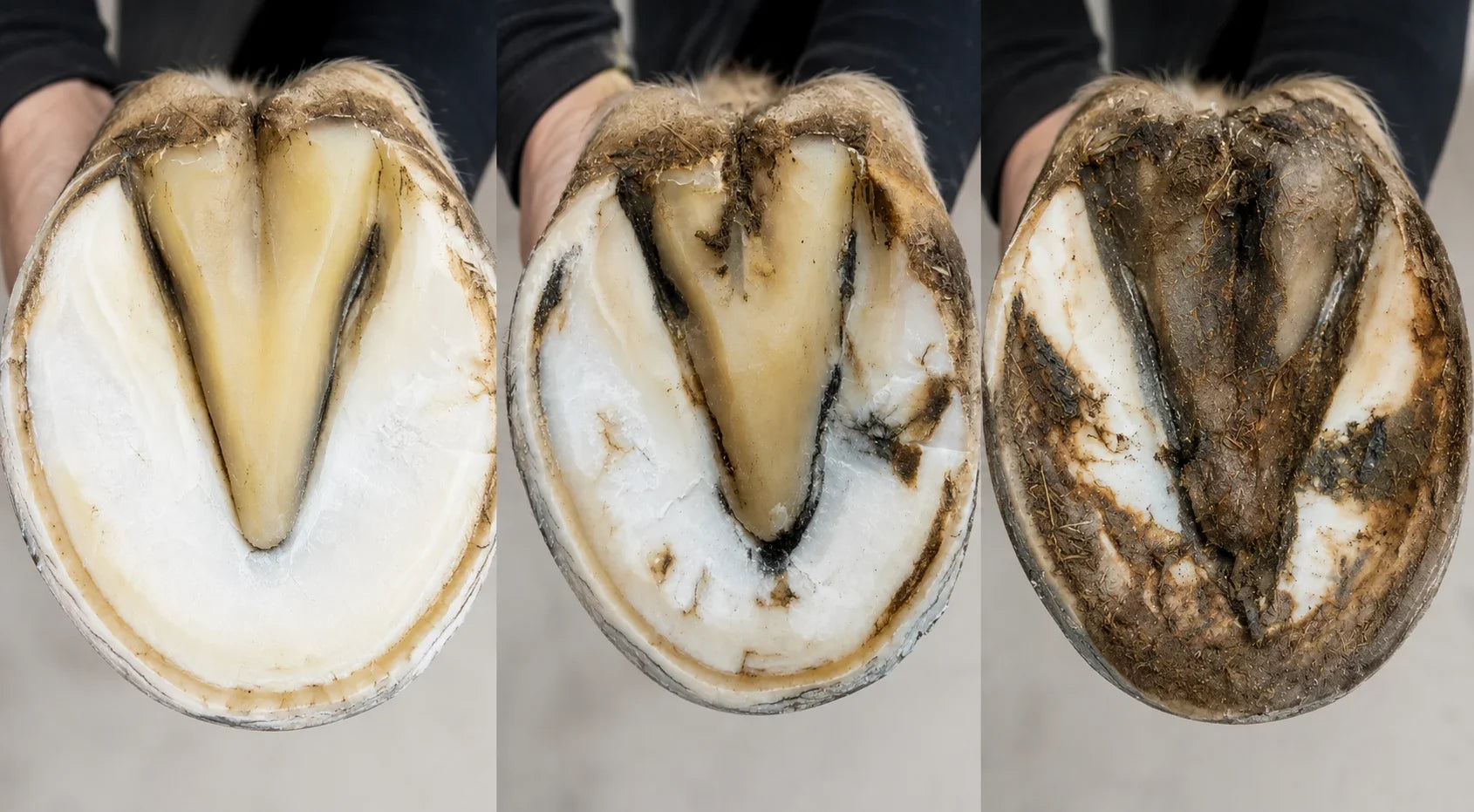
Share:
Radiating thrush
Recognizing thrush in its early stages: The first warning signs