

Choose care products based on their purpose and findings
When you discover thrush in your horse's hoof, it is understandable that you look for a product that will help as quickly as possible. Cleaners, liquids, pastes, sprays, powders and home remedies are available.
However, the crucial question is not simply: “What is the best remedy for thrush?” Much more important is: “What does this hoof need at this care step?”
You should clean a dirty hoof first. Loose or undermined areas of horn may need to be professionally opened up. Only then can a targeted frog-care product reach the area that is actually affected.
This guide explains what types of products are available, how they differ and which Hoofgold solution is suitable for each step of frog care.

Olaf's advice on choosing products
The best product is not automatically the strongest one - it is the one that suits the task and the hoof's current condition. Therefore, first check whether you want to clean, care for an accessible frog area, treat a deep groove or support horn quality over the long term.
In this guide, Olaf and the Hoofgold team will help you distinguish between the individual care steps. This allows you to choose more precisely and avoid combining several products at random.
The best remedy for thrush: the short answer
There is no single product that is automatically the best choice in every situation. An effective care plan usually consists of several coordinated steps:
- Clean: Remove dirt and prepare the hoof for further care.
- Make it accessible: Have loose or undermined areas of horn professionally assessed and removed if necessary.
- Targeted care: Apply a suitable frog-care product to the affected areas.
- Care for deep grooves: Treat hard-to-reach areas in a controlled manner and according to the product instructions.
- Correct the causes: Improve moisture management, hygiene, exercise and hoof trimming.
- Support hoof horn over the long term: If horn quality is poor, review the entire hoof-care routine.
What should you consider when selecting a product for thrush?
Do not choose a product solely based on advertising, color, smell, or the strongest possible effect. What matters is the condition of your horse's hoof and the specific goal of the application.
1. How deep is the change?
A superficial, accessible change may require different care than a deep central frog groove that extends far between the bulbs.
2. Is the horn firm, soft, or already open?
Highly drying or irritating products can work differently on firm, dead horn than on sensitive or open tissue.
3. Is the affected area clean and accessible?
Dirt, loose horn flaps, and undermined pockets can prevent a product from reaching the actual problem area.
4. What should the product do?
- Cleaning the hoof
- Targeted local frog care
- Application in deep grooves
- Supporting overall horn quality
5. Is there pain or lameness?
In case of bleeding, severe pain, lameness, heat, swelling, or deep tissue damage, you should not make the choice on your own. Seek support from a veterinarian and a qualified hoof-care professional.
You can find a complete step-by-step guide later at: Treating thrush: step-by-step guide .
Products for preparatory hoof cleaning
Before applying a targeted frog-care product, the hoof should be clean and the affected area visible. First remove coarse dirt with a hoof pick and brush.
A hoof cleaner can support this preparatory step. Its purpose is not to replace all subsequent treatment steps, but to loosen dirt and prepare the hoof for targeted care.
When is a hoof cleaner useful?
- When manure and dirt become deeply lodged in the grooves
- Before applying a local frog-care product
- When the hoof needs to be checked and cleaned regularly
- As part of a repeatable care routine
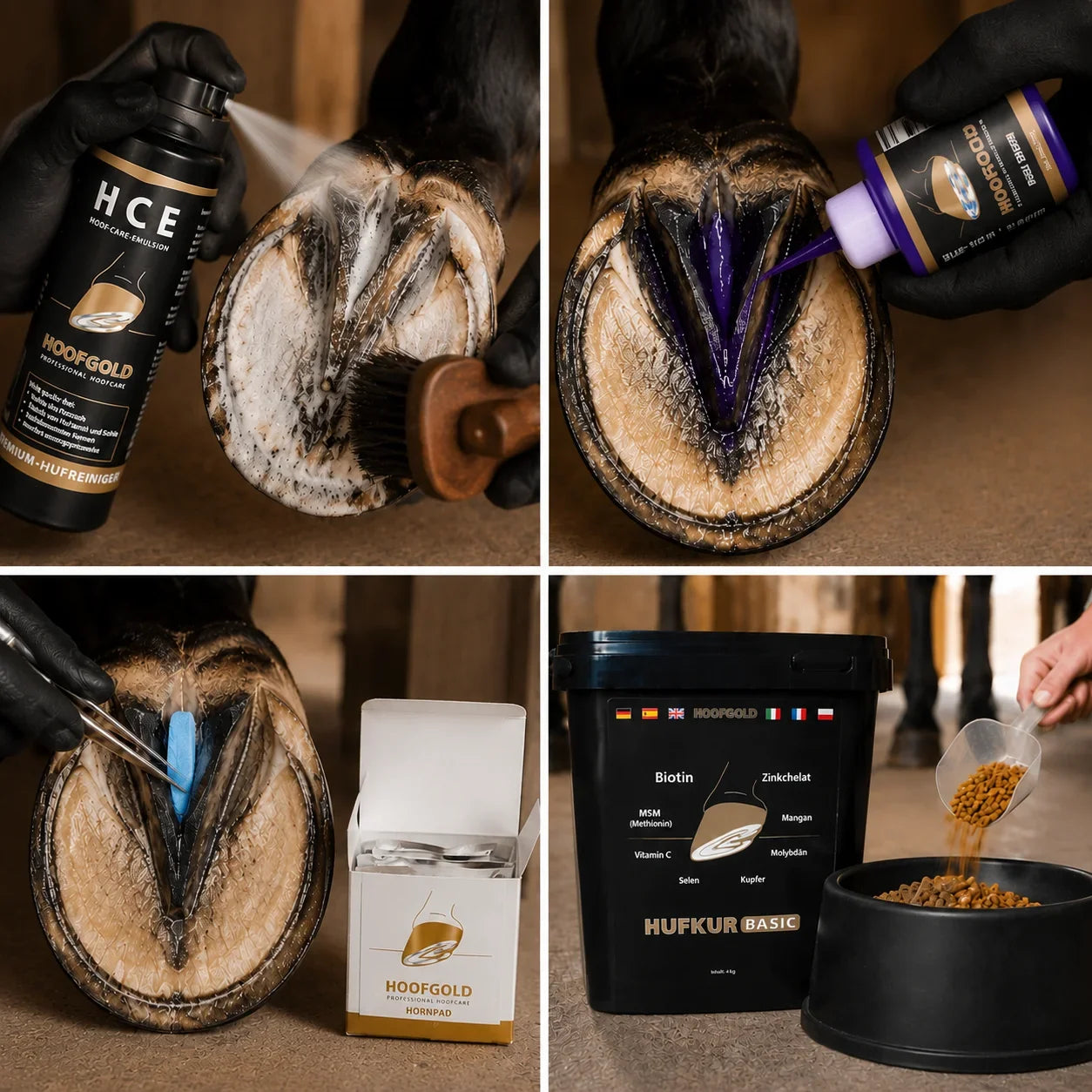
Hoofgold HCE Hoof Cleaner
The HCE hoof cleaner is intended for the preparatory cleaning phase. It is designed to help clean the hoof thoroughly before the actual frog care begins.
 View HCE hoof cleaner

Targeted frog care products
After cleaning and proper preparation, targeted local care follows. Apply the product so that it reaches the areas actually affected, and follow the instructions precisely.
What should a frog care product do?
- Enable targeted application to problematic frog areas
- Allow clear dosing and repeated application
- Be suitable for the intended hoof condition
- Have clear, understandable product instructions
- Be part of a complete care plan
A local care product is particularly useful when the problem area is clean, accessible, and as dry as possible.
Hoofgold BlueStuff
BlueStuff was developed for targeted care of problematic frog areas. After cleaning and preparation, it forms part of the local care step.
 View Hoofgold BlueStuff

Products and aids for deep frog grooves
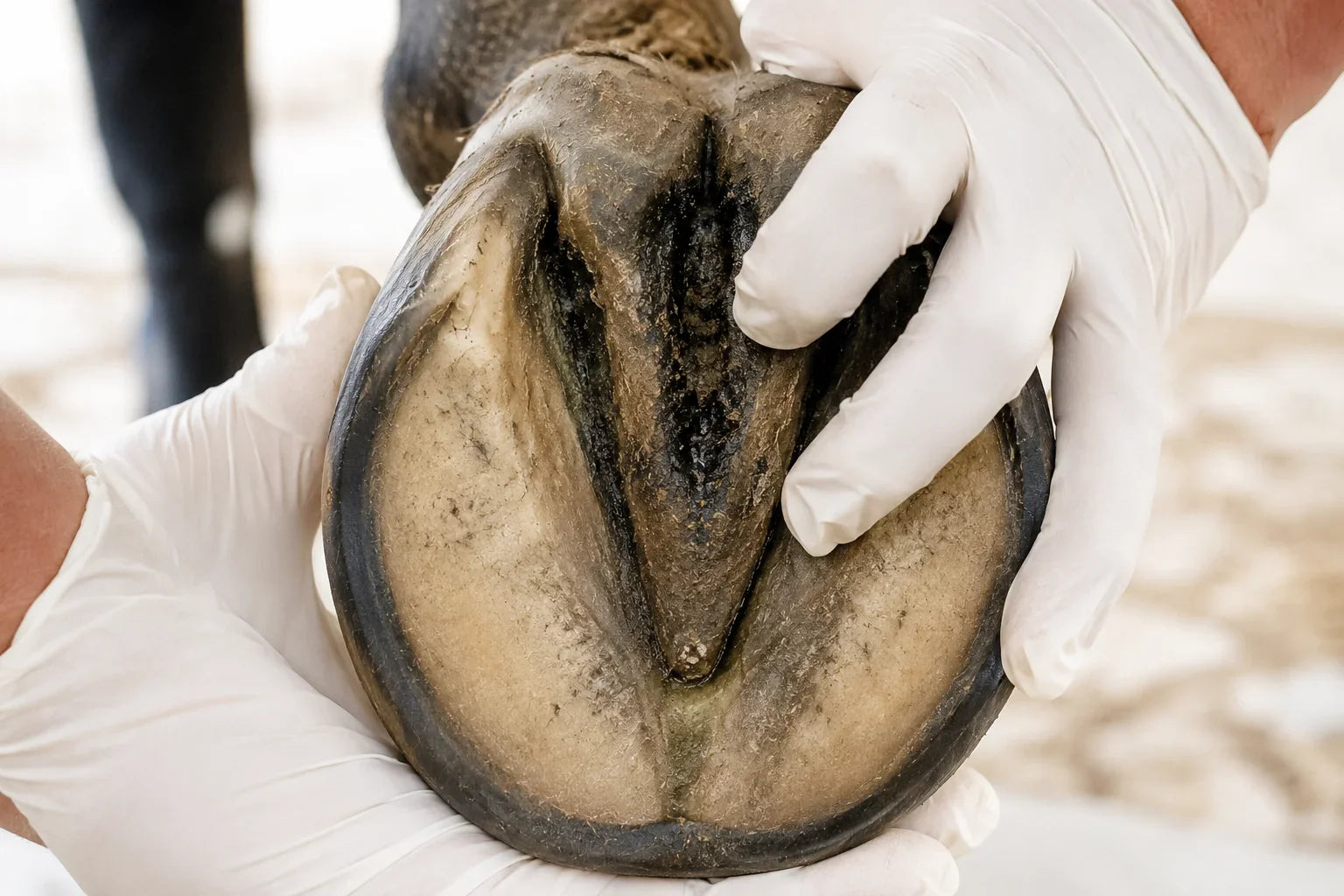
Deep central frog grooves are particularly challenging. They can be narrow, poorly ventilated, and difficult to keep clean. The care product must reach the problem area without trapping dirt or moisture underneath.
Important for deep grooves:
- Have the area thoroughly assessed beforehand
- Remove dirt and loose debris
- Do not blindly push unsuitable materials into the area
- Do not put pressure on sensitive areas
- Check the area again regularly
Hoofgold Hornpads
Depending on the findings, Hornpads can help place a suitable care product in hard-to-reach frog grooves in a controlled manner.
They should not be used simply to cover a dirty, bleeding, or inadequately assessed area.
 View Hoofgold Hornpads
Long-term support for hoof horn quality
Local frog care acts on the affected area. If your horse also has soft, brittle, or slow-growing horn, you should also consider the overall hoof care routine.
Hoof horn quality is influenced by several factors:
- Overall feeding and nutrient supply
- Metabolism and overall health
- Housing and moisture
- Movement and circulation
- Care routine
- Individual predisposition
A complementary feed does not replace local care or necessary professional treatment. However, it can be part of a long-term approach when general horn quality is to be supported.
Hoofgold Hufkur
Hoofgold Hufkur is designed as a complementary feed to support hoof care. It is not part of the acute local treatment step, but rather of the long-term support of hoof horn growth.
 View Hoofgold Hufkur
Hoofgold remedies for thrush compared
| Product | Care step | Goal | Important |
|---|---|---|---|
| HCE Hoof Cleaner | Preparation | Clean the dirty hoof | Use before targeted local care |
| BlueStuff | Targeted thrush care | Care for problematic frog areas | Use only on cleaned and accessible areas |
| Hornpads | Deep grooves | Support targeted application in hard-to-reach areas | Do not apply to unexplained or dirty areas |
| Hufkur | Long-term support | Support general hoof care and horn quality | Does not replace local treatment |
Liquid, paste, powder or spray: Which is better?
The form alone does not determine whether a product is good or bad. Each form has practical advantages and disadvantages.
Liquid products
Liquids can often be applied well to narrow areas. However, they may run off more quickly and must be applied precisely.
Pastes or viscous products
Thicker products may remain in one place for longer. However, they must not be applied to dirty areas, as deposits may otherwise become trapped.
Powders
Powders can have a drying effect and spread into grooves. Special care is required in deep, open or sensitive areas.
Sprays
Sprays are easy to apply and are suitable for larger or easily accessible areas. They do not always reliably reach very deep grooves.
More important than the form is whether the product is intended for the condition, is used correctly and actually reaches the affected area.
Home remedies or ready-made thrush care product?
In your search, you will probably also come across home remedies such as copper sulfate, iodine, vinegar or hydrogen peroxide. Some have drying or antimicrobial properties.
The disadvantage of self-mixed solutions often lies in:
- unclear concentration,
- missing dosage instructions,
- uncertain tissue compatibility,
- of different compositions and
- the risk of irritating sensitive tissue.
A ready-made hoof-care product offers a clearer formulation and application recommendation. However, even a ready-made product can only work effectively if you prepare the hoof and take the cause into account.
You can find a detailed classification under: Home remedies for thrush: What helps and what can cause harm? .
Which solution is right for which severity?
| Finding | Possible need for care | Professional help |
|---|---|---|
| Mild odor, small superficial change | Cleaning, monitoring and appropriate local care | In case of uncertainty or deterioration |
| Soft hoof horn and recurring dark deposits | Thorough preparation and consistent frog care | Hoof-care professional to assess loose areas |
| Deep central frog sulcus | Targeted care of hard-to-reach areas | Professional assessment of hoof shape and cleft depth |
| Pain, bleeding or lameness | Not self-treatment alone | Veterinarian and qualified hoof-care professional |
How to use thrush treatments correctly
- Inspect the hoof: Assess depth, odor, hoof horn quality and sensitivity.
- Remove coarse dirt: Carefully loosen manure, soil and deposits.
- Have loose areas professionally assessed: If necessary, have undermined hoof horn made accessible.
- Clean the hoof: Use the intended cleaner according to the instructions.
- Dry as much as possible: Reduce excess moisture before local care.
- Apply specifically: Apply the product to the actual problem areas.
- Repeat consistently: Follow the frequency and duration specified in the product instructions.
- Document progress: Compare photos, odor, hoof horn quality and sensitivity.
Common mistakes when choosing a treatment for thrush
Automatically assuming the strongest product is the best
Highly drying or irritating products can place additional strain on sensitive tissue.
Mix several products together without control
Unclear combinations can alter the effect or irritate the tissue.
Apply the product to dirt
A product cannot reliably reach the affected area if debris and loose horn block access.
Choosing based only on price
Suitability, clear application instructions, tissue condition, and the specific treatment goal are decisive.
Ignoring the cause
Persistent moisture, deep grooves, little exercise, and unsuitable hoof trimming can undermine the success of any product.
Stopping too early
Less odor does not automatically mean that the frog structure has already been fully stabilized.
When is a product for thrush no longer sufficient?
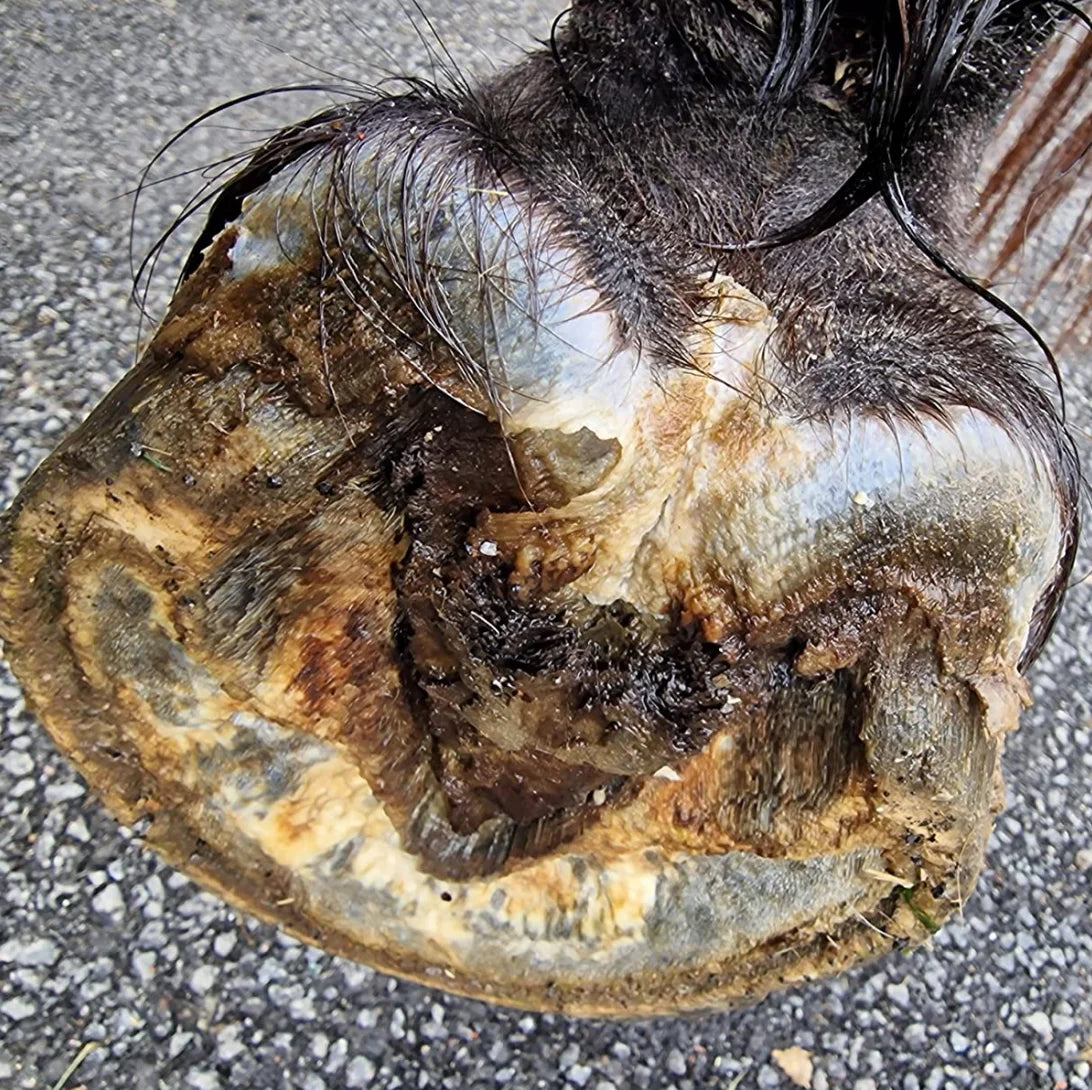
The hoof should be professionally assessed if any of the following signs occur:
- lameness or marked sensitivity
- bleeding
- strong pain response
- heat or swelling
- deep cracks between the bulbs
- conspicuous or proliferating tissue
- no improvement despite consistent care
- unclear distinction from hoof cancer or other diseases
In these cases, you should not simply switch to a more aggressive product. A veterinarian and qualified hoof-care professional should assess the condition together.
Hoofgold practical tip
Olaf's practical tip: Practical hoof work repeatedly shows that the product is only part of the solution. The right sequence often makes the decisive difference.
- Assess
- Clean
- Make accessible
- Provide targeted care
- Correct the causes
- Monitor progress
If you follow this sequence, you can use every product more effectively and in a more controlled way. If you are unsure about a care step, your hoof-care professional and the Hoofgold team will be happy to help.

Frequently asked questions about products for thrush
What is the best product against thrush?
The best product depends on the care step and the condition of the hoof. Cleaning, targeted local care, treatment of deep grooves, and long-term hoof support serve different purposes.
Which product works quickly against thrush?
A rapid visible change is not the same as sustainable stabilization. Thorough preparation, consistent care, and eliminating the underlying cause at the same time are decisive.
Is a frog-care product alone sufficient?
Often not. Loose horn, deep grooves, moisture, stable hygiene, exercise, and hoof balance must also be taken into account.
Why does the hoof need to be cleaned before application?
Dirt and debris can prevent the product from reaching the affected area. In addition, the condition of a clean hoof is easier to assess.
Can I use several products at the same time?
Products should not be mixed without proper control. Follow the respective instructions and consult a qualified professional about combinations.
Is a highly drying treatment better?
Not automatically. Highly drying or caustic treatments can damage sensitive or horn-producing tissue.
Which form is better: liquid or paste?
Both forms can be useful. Liquids reach narrow areas more easily, while pastes may stay in one place longer. The findings, access and correct application are decisive.
Which treatment is suitable for deep frog grooves?
Deep grooves must first be cleaned and professionally assessed. An appropriate care product can then be applied in a targeted manner. Aids must not trap dirt or sensitive tissue.
Are home remedies just as good as ready-made products?
Home remedies may have suitable properties in some cases, but their concentration and tissue compatibility are often unclear. Ready-made products usually offer clearer application instructions.
How often must a treatment be applied?
The frequency depends on the product and the findings. Follow the product instructions and the recommendation of the hoof-care professional overseeing the case.
How long should thrush be treated?
Care should not be discontinued merely because the odor subsides. What matters is cleaner grooves, stronger horn and a lasting improvement.
When should a veterinarian be consulted?
In cases of lameness, bleeding, severe pain, heat, swelling, deep tissue damage or no improvement, a veterinarian should examine the hoof.
The right solution for every care step
You do not have to choose the right solution alone. A good frog-care routine does not consist of a randomly selected individual product. Cleaning, targeted local care, care for deep grooves and long-term hoof support must work together sensibly.
Olaf and the Hoofgold team want to help you correctly assess your horse’s needs and find a well-considered solution for every care step.
Discover Hoofgold frog care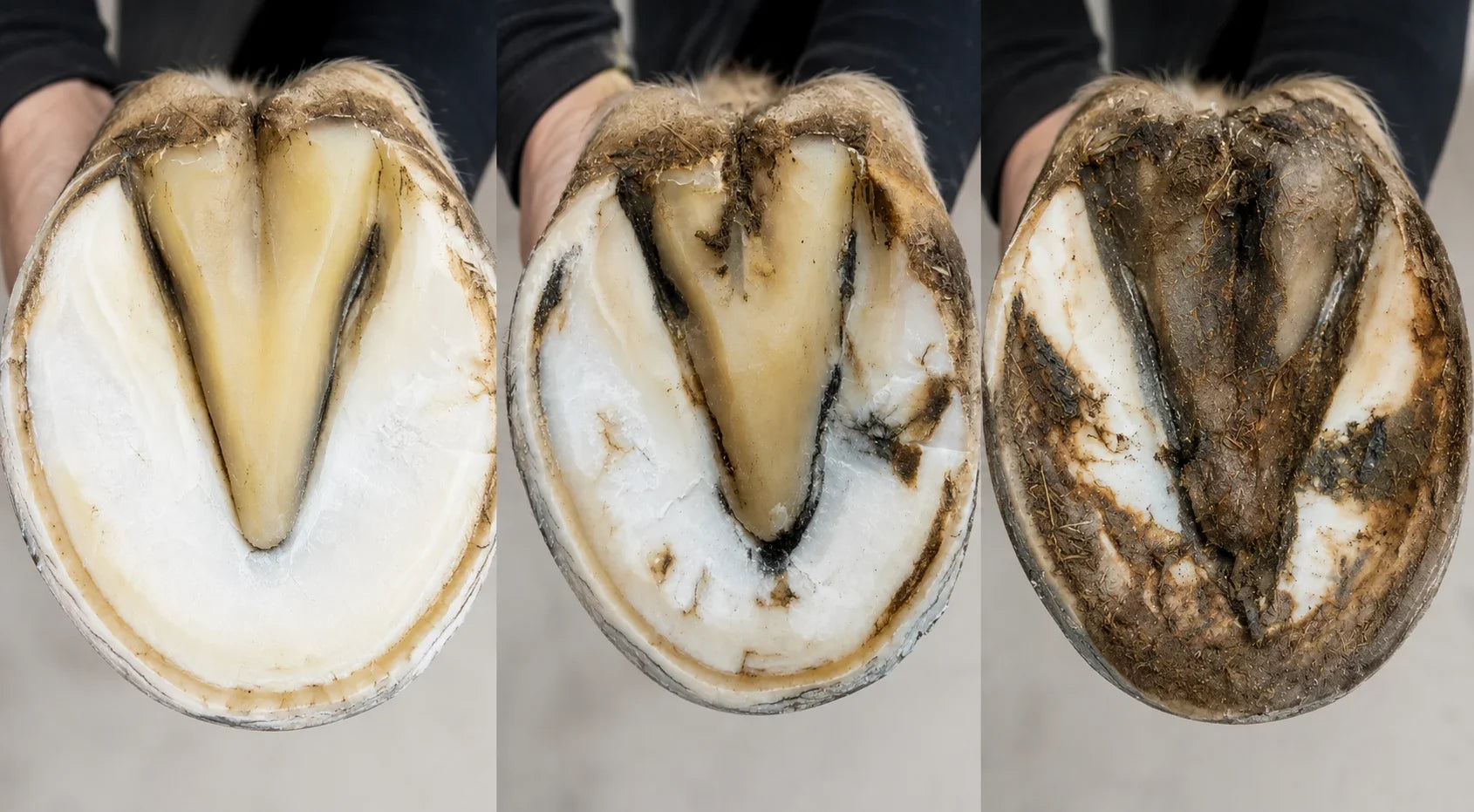
Share:
Home remedies for thrush: What helps and what can cause harm?
Severe thrush in horses: warning signs and the right approach